
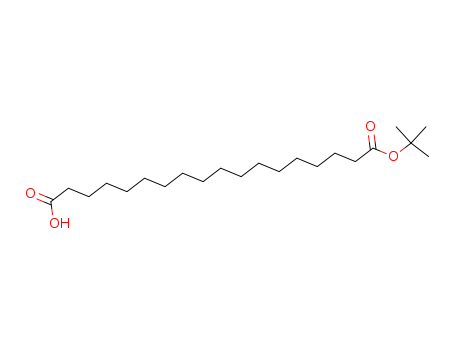
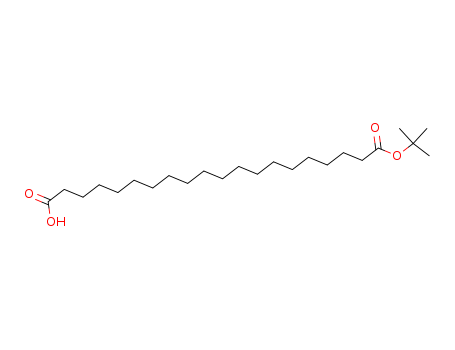
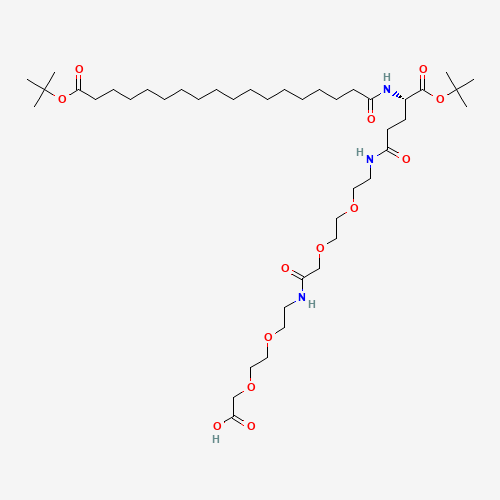
![Fmoc-L-Lys[C20-OtBu-γ-Glu(OtBu)-AEEA-AEEA]-OH](/upload/2026/7/89-1.jpg "Fmoc-L-Lys[C20-OtBu-γ-Glu(OtBu)-AEEA-AEEA]-OH")
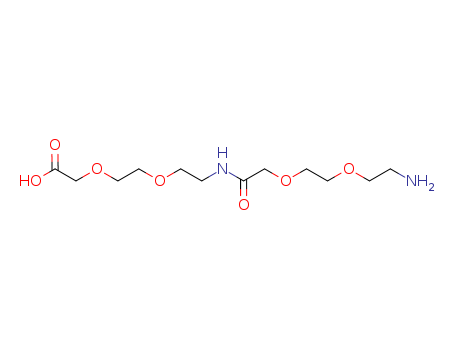
AEEA-AEEA | CAS 1143516-05-5
- cas:1143516-05-5
- Molecular Formula:C12H24N2O7
- Purity:99%
- Molecular Weight:308.332
Product Details
CasNo: 1143516-05-5
Molecular Formula: C12H24N2O7
Product Overview
AEEA-AEEA (CAS 1143516-05-5) is a bifunctional, PEG-like linker intermediate containing a terminal primary amine, a carboxylic acid group, an internal amide bond, and multiple ether linkages. Its chemical name is 17-amino-10-oxo-3,6,12,15-tetraoxa-9-azaheptadecanoic acid.
With a molecular formula of C₁₂H₂₄N₂O₇ and a molecular weight of 308.33 g/mol, AEEA-AEEA is used as a building block in peptide modification, linker development, and conjugation-related chemical research.
The molecule provides two different terminal functional groups for further chemical transformation. Its ether-containing spacer can also introduce additional chain length and flexibility into a designed molecular construct. Appropriate protection and coupling strategies are important when incorporating AEEA-AEEA into multistep syntheses.
Shandong Juntai Pharmaceutical Co., Ltd. supplies AEEA-AEEA for B2B research and development projects, with product specifications and technical requirements reviewed according to individual project needs.
Basic Information
| Property | Details |
|---|---|
| Product Name | AEEA-AEEA |
| CAS Number | 1143516-05-5 |
| Chemical Name | 17-Amino-10-oxo-3,6,12,15-tetraoxa-9-azaheptadecanoic acid |
| Alternative Name | H-AEEA-AEEA-OH |
| Molecular Formula | C₁₂H₂₄N₂O₇ |
| Molecular Weight | 308.33 g/mol |
| Listed Purity | 99%; batch-specific results subject to the applicable COA |
| Chemical Classification | PEG-like bifunctional linker intermediate |
| Functional Groups | Primary amine, carboxylic acid, amide, and ether groups |
| Research Applications | Peptide modification, linker development, and conjugation chemistry |
| PubChem CID | 51340918 |
| Intended Use | Research and development only |
Key Structural Features
Bifunctional Amine and Carboxylic Acid Terminals
AEEA-AEEA contains a primary amino group at one end and a carboxylic acid group at the other. These functional groups offer different reaction sites for incorporation into larger molecular structures.
Under suitable conditions, the carboxylic acid can be activated for amide-bond formation with an amine-containing partner, while the terminal amino group can participate in subsequent functionalization.
Reaction selectivity requires particular attention. Because both terminal groups are present in the unprotected molecule, protecting-group selection and reaction sequence should be evaluated to minimize undesired side reactions.
Flexible Ether-Containing Spacer
The structure incorporates multiple ether linkages separated by short carbon chains, together with an internal amide linkage.
This arrangement provides a flexible, relatively polar spacer for molecular design. Compared with a single AEEA unit, AEEA-AEEA incorporates an extended linker structure that may be useful where greater separation between connected molecular components is desired.
The influence of the spacer on solubility, steric accessibility, or molecular behavior depends on the complete conjugate and should be assessed experimentally.
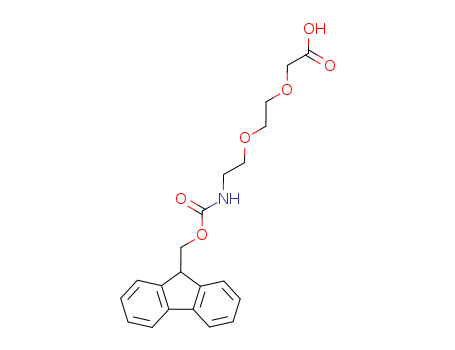
Distinction Between AEEA-AEEA and Fmoc-AEEA
Although both compounds are relevant to linker and peptide chemistry, AEEA-AEEA and Fmoc-AEEA are different chemical substances.
AEEA-AEEA (CAS 1143516-05-5) contains an unprotected primary amino group and a terminal carboxylic acid, with an internal amide linkage.
In contrast, Fmoc-AEEA (CAS 166108-71-0) contains an Fmoc-protected amino group. The protecting group and molecular structure influence how each building block is incorporated into a synthesis.
Selection should therefore be based on the required spacer architecture, functional-group protection, and reaction sequence rather than product-name similarity alone.
Research Applications
Peptide Linker Design and Modification
AEEA-AEEA can be used as an intermediate in the design of peptide-linked molecular constructs.
Its amino and carboxylic acid termini provide sites for chemical coupling, while the ether-containing chain contributes a flexible spacer segment. This makes the compound relevant to research involving peptide modification and the development of linker-containing intermediates.
The appropriate coupling conditions, protecting groups, and purification strategy depend on the peptide sequence and the desired final structure.
For more background on this application, see AEEA-AEEA in Peptide Synthesis and Bioconjugation.
Bioconjugation and Functional Linker Development
Bifunctional linkers are useful in the preparation of molecular constructs that require a defined connection between different chemical components.
AEEA-AEEA provides an amino-acid-like linker framework that can be further modified to introduce application-specific functionality.
For conjugation projects, researchers should evaluate terminal-group compatibility, linker length, functional-group protection, and the stability of bonds formed during synthesis.
ADC and PROTAC Linker Research
AEEA-AEEA is also described in commercial technical literature as a linker building block for research involving antibody-drug conjugates (ADCs) and proteolysis-targeting chimeras (PROTACs).
Its ether-containing spacer and bifunctional structure can be considered when designing linker architectures for these research systems.
However, AEEA-AEEA is not a universal, ready-to-use conjugation reagent. Suitability depends on the target molecular structure, coupling chemistry, linker functionalization, and overall research requirements.
Further discussion is available in AEEA-AEEA: PEG-Based Linker Intermediate for ADC and PROTAC Research.
Custom Synthesis & Project Support
Shandong Juntai Pharmaceutical Co., Ltd. supports B2B chemical research and development activities involving pharmaceutical intermediates, peptide-related building blocks, and custom synthesis projects.
For AEEA-AEEA (CAS 1143516-05-5), project discussions may cover:
-
Product specifications: Required purity, chemical identity, and relevant impurity considerations.
-
Analytical requirements: Available batch documentation and project-specific analytical expectations.
-
Packaging requirements: Packaging quantities and handling needs appropriate to the intended research application.
-
Custom synthesis: Feasibility assessment for related linker intermediates, protected derivatives, or project-specific structural requirements.
-
Supply planning: Quantity requirements, anticipated delivery schedules, and technical coordination.
Product availability, analytical documentation, and custom synthesis feasibility are confirmed based on the actual specification and project scope.
Frequently Asked Questions
What is the minimum order quantity (MOQ) for AEEA-AEEA?
The minimum order quantity depends on the requested specification, available material, and project requirements. Customers may provide their target quantity when submitting a technical or commercial inquiry so that an appropriate supply arrangement can be evaluated.
Is a Certificate of Analysis (COA) available for AEEA-AEEA?
Batch-related analytical documentation can be discussed during product evaluation. Customers requiring a COA, HPLC results, mass spectrometry data, or specific impurity information should confirm which documents and testing methods are available for the intended batch before ordering.
Can AEEA-AEEA be supplied for custom synthesis or larger research projects?
Project-specific quantity requirements and custom synthesis requests can be evaluated individually. Technical feasibility, specifications, production scheduling, and delivery arrangements depend on the agreed project scope.
What packaging options are available?
Packaging is determined according to the available product format, required quantity, and handling considerations. Customers with specific packaging preferences should communicate them during the inquiry process.
How should AEEA-AEEA be stored and transported?
Storage and handling conditions should follow the applicable product label, Safety Data Sheet (SDS), and batch-specific technical documentation. Requirements may differ according to packaging, material condition, and transportation arrangements. The appropriate conditions should be confirmed before shipment.
What information should be included in an AEEA-AEEA inquiry?
To support an accurate technical and commercial assessment, customers are encouraged to provide CAS 1143516-05-5, required quantity, target purity, analytical documentation requirements, and destination country. Additional information about the intended research application may help determine whether a standard product or a project-specific synthesis approach is more suitable.
For research and development use only.
Relevant Products
-
 Fmoc-Glu(OtBu)-Gly-Gly-OH
CAS:N/A
-
 Fmoc-AEEA
CAS:166108-71-0
-
 Pal-Glu(OH)-OtBu
CAS:536721-25-2


