
![Fmoc-L-Lys[C20-OtBu-γ-Glu(OtBu)-AEEA-AEEA]-OH](/upload/2026/7/89-1.jpg "Fmoc-L-Lys[C20-OtBu-γ-Glu(OtBu)-AEEA-AEEA]-OH")
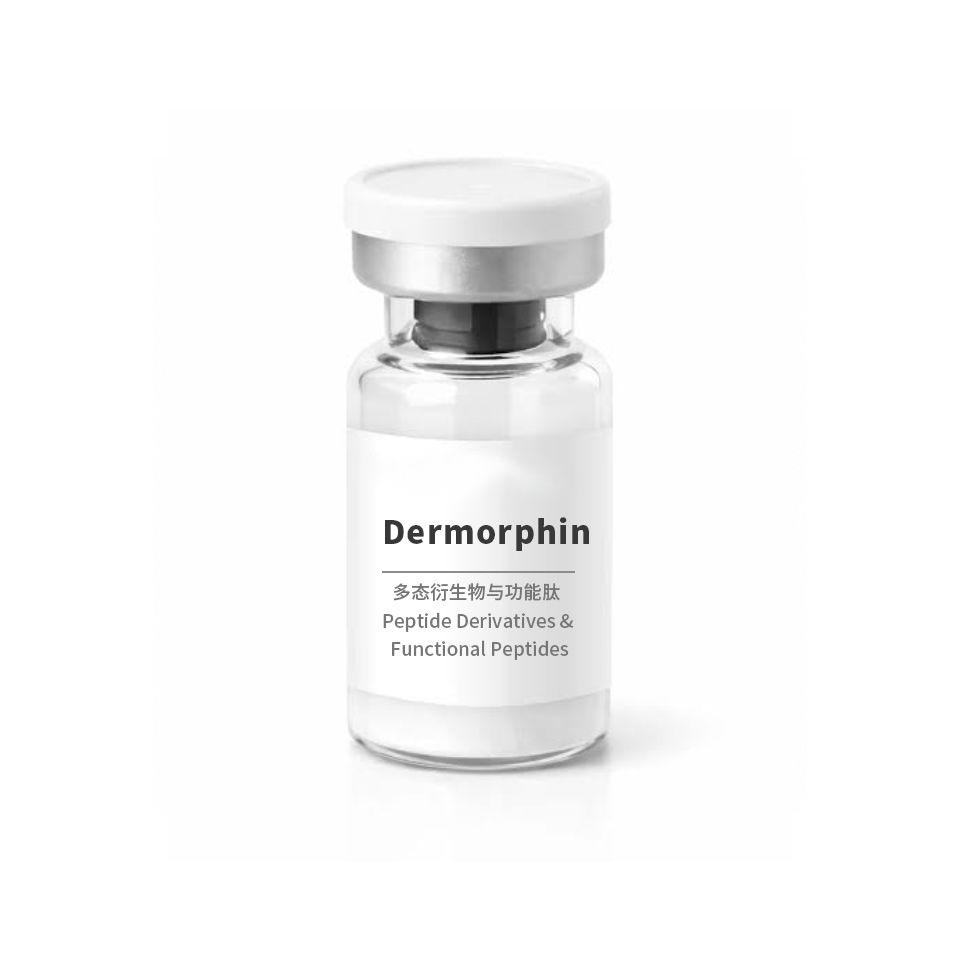
Dermorphin | CAS /
- cas:/
- Molecular Formula:C40H50N8O10
- Purity:99%
- Molecular Weight:
Product Details
CasNo: /
Molecular Formula: C40H50N8O10
Product Overview
Dermorphin, CAS 77614-16-5, is a naturally occurring heptapeptide with the amino acid sequence Tyr-D-Ala-Phe-Gly-Tyr-Pro-Ser-NH2.
The peptide is structurally notable for two features: a D-alanine residue at position 2 (D-Ala²) and a C-terminal amide. These characteristics distinguish Dermorphin from many conventional short peptides composed entirely of L-amino acids.
Dermorphin has been widely studied as a peptide ligand in mu-opioid receptor (MOR / OPRM1) research and as a model for investigating peptide–receptor recognition, stereochemistry, and structure–activity relationships.
Basic Information
| Item | Information |
|---|---|
| Product Name | Dermorphin |
| CAS No. | 77614-16-5 |
| Molecular Formula | C40H50N8O10 |
| Molecular Weight | Approx. 802.9 g/mol |
| Peptide Length | 7 amino acids |
| Sequence | Tyr-D-Ala-Phe-Gly-Tyr-Pro-Ser-NH2 |
| Key Structural Feature | D-Ala² |
| C-Terminus | Amidated (-NH2) |
| Peptide Type | Heptapeptide / Opioid Peptide |
| Research Target | Mu-opioid receptor (MOR / OPRM1) |
Structural Features
D-Alanine at Position 2
One of the most distinctive features of Dermorphin is the presence of D-alanine at the second residue.
Most naturally occurring peptides are composed predominantly of L-amino acids. The presence of a D-amino acid makes Dermorphin a useful molecular model for studying how stereochemistry can influence peptide conformation, receptor recognition, and ligand–receptor interactions.
C-Terminal Amidation
Dermorphin terminates in Ser-NH2, giving the peptide a defined C-terminal amide.
C-terminal amidation is an important structural feature in many biologically active peptides and can influence molecular charge, conformation, receptor interaction, and analytical behavior.
Compact Seven-Residue Sequence
Although Dermorphin contains only seven amino acids, its combination of D-amino-acid stereochemistry and terminal amidation gives the peptide a distinctive molecular profile.
Its defined sequence also makes it suitable as a reference structure in comparative studies of short peptide analogs and modified peptide sequences.
Research Background
Mu-Opioid Receptor Research
Dermorphin has been extensively investigated in relation to the mu-opioid receptor (MOR), encoded by the OPRM1 gene.
Research involving Dermorphin has contributed to the understanding of:
- Peptide–receptor recognition
- Ligand binding selectivity
- Receptor pharmacology
- Short-peptide conformational behavior
- Amino-acid stereochemistry in receptor interaction
These studies are generally conducted using receptor-binding assays, cellular models, biochemical systems, or other controlled research platforms.
Peptide–Receptor Interaction Studies
The short and well-defined sequence of Dermorphin provides a useful model for studying how individual amino-acid residues contribute to receptor recognition.
Particular attention is often given to the influence of D-Ala², aromatic residues, and terminal amidation on peptide conformation and receptor interaction.
Structure–Activity Relationship Research
Dermorphin has also been used as a reference peptide in structure–activity relationship (SAR) studies.
Research may compare:
- D- versus L-amino-acid substitutions
- Individual residue replacements
- Sequence truncation
- Terminal modifications
- Related peptide analogs
Such studies help clarify the relationship between peptide structure, stereochemistry, and receptor recognition.
Analytical and Structural Characterization
Dermorphin can be characterized using standard peptide analytical techniques.
Common research methods include:
- High-performance liquid chromatography (HPLC)
- Mass spectrometry (MS)
- LC-MS analysis
- Molecular-weight verification
- Sequence confirmation
- Terminal-modification analysis
Because Dermorphin contains a D-amino-acid residue and a C-terminal amide, analytical interpretation should consider both the amino-acid sequence and the defined terminal structure.
Frequently Asked Questions
What makes Dermorphin structurally unusual?
Dermorphin contains D-alanine at position 2, while most naturally occurring peptide sequences are dominated by L-amino acids. It also has a C-terminal amide.
How many amino acids are present in Dermorphin?
Dermorphin is a seven-amino-acid peptide, or heptapeptide.
What is the amino acid sequence of Dermorphin?
The sequence is:
Tyr-D-Ala-Phe-Gly-Tyr-Pro-Ser-NH2
Which receptor is commonly studied with Dermorphin?
Dermorphin is most commonly associated with research involving the mu-opioid receptor (MOR / OPRM1).
Why is D-Ala² important in Dermorphin research?
The D-configuration at position 2 provides a useful model for studying how amino-acid stereochemistry influences peptide conformation and receptor recognition.
Which analytical techniques are commonly used to characterize Dermorphin?
HPLC, MS, LC-MS, molecular-weight verification, and sequence-related analyses are commonly used in peptide characterization research.
This page is provided for scientific and informational purposes only.
Relevant Products
-
 Fmoc-Glu(OtBu)-Gly-Gly-OH
CAS:N/A
-
 Glucagon
CAS:16941-32-5
-
 Ipamorelin
CAS:170851-70-4


