
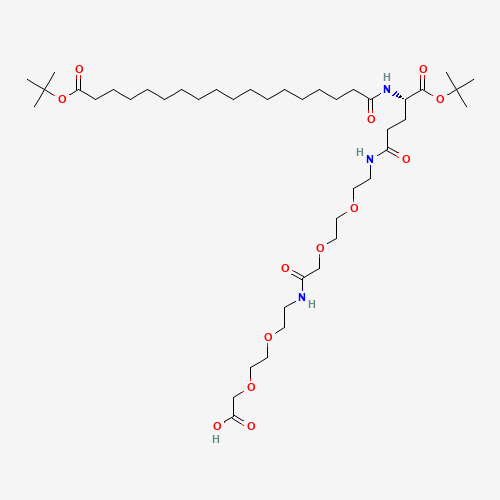
CAS 1662688-20-1 for Semaglutide: Building Block Quality and Supplier Evaluation
2026.10.15
In semaglutide solid-phase peptide synthesis (SPPS), introducing the C18 fatty acid side chain at the Lys26 residue is an important consideration in process development. CAS 1662688-20-1, chemically identified as Fmoc-L-Lys[Oct-(OtBu)-Glu-(OtBu)-AEEA-AEEA]-OH, is a preassembled lipidated lysine building block designed to incorporate this complex side-chain structure into the peptide sequence.
For pharmaceutical manufacturers and peptide process development teams, sourcing this type of building block involves more than comparing product specifications and prices. The quality of the intermediate, the supplier's manufacturing capabilities, and the availability of reliable analytical documentation can all affect downstream synthesis and quality control.
Buyers searching for a CAS 1662688-20-1 supplier should evaluate not only product availability, but also manufacturing capabilities, batch consistency, and supporting analytical documentation.
So, how should buyers evaluate a Semaglutide intermediate supplier and determine whether a CAS 1662688-20-1 building block meets their process requirements? This article examines its chemical identity, role in SPPS, supplier qualifications, and key quality attributes that buyers should review before purchasing.
What Is CAS 1662688-20-1?
CAS 1662688-20-1 is a preassembled, lipidated lysine building block used in semaglutide synthesis.
Its chemical characteristics include:
| Property | Information |
|---|---|
| CAS Number | 1662688-20-1 |
| Chemical Name | Fmoc-L-Lys[Oct-(OtBu)-Glu-(OtBu)-AEEA-AEEA]-OH |
| Molecular Formula | C64H101N5O16 |
| Molecular Weight | Approximately 1196.5 g/mol |
| Key Structural Features | Fmoc-protected lysine, C18 fatty acid-derived moiety, γ-Glu, and two AEEA units |
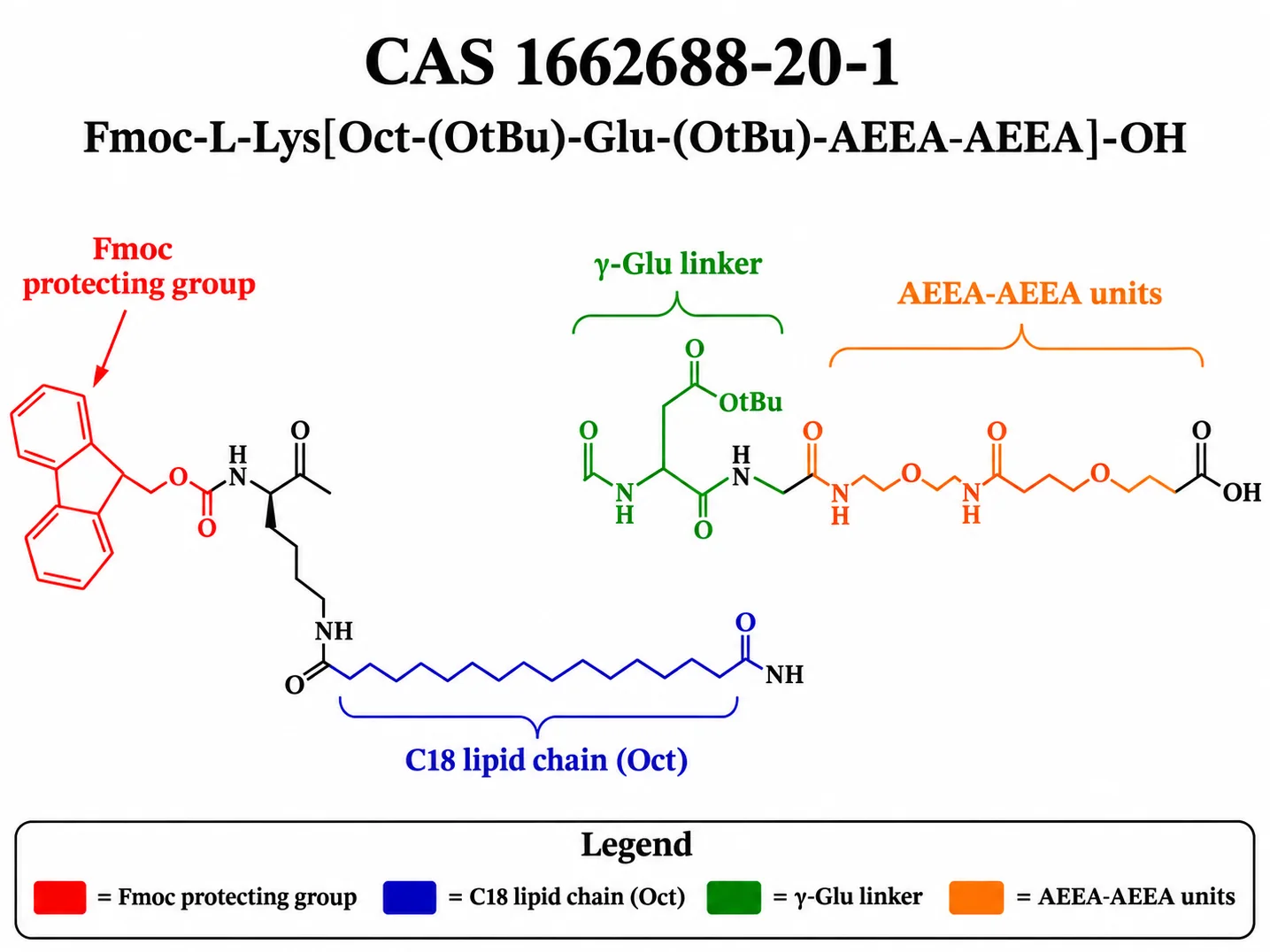
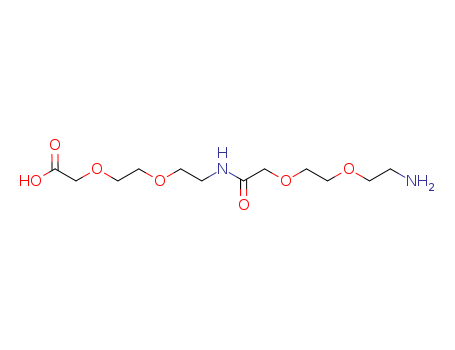
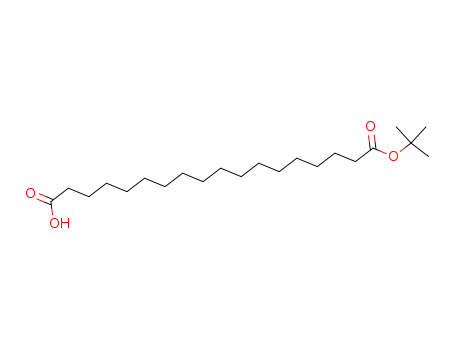
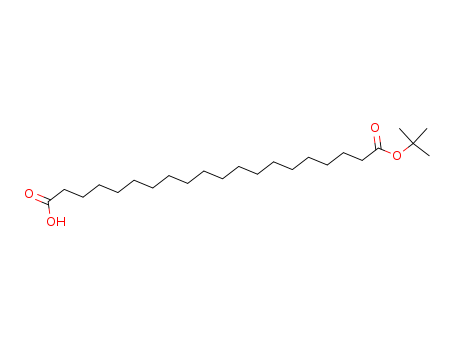
The molecule consists of an Fmoc-protected lysine backbone and a preassembled side chain containing a C18 fatty acid-derived structure, a γ-glutamyl (γ-Glu) linker, and two AEEA units (8-amino-3,6-dioxaoctanoic acid).
The two AEEA units form an AEEA-AEEA linker segment within the preassembled lipidated side chain.
When evaluating this product, buyers should pay close attention to its protecting groups and functional-group configuration.
For example, CAS 1662688-20-1 and CAS 1118767-16-0 are both associated with semaglutide side-chain chemistry, but they have different structural configurations and protection patterns. They are not interchangeable materials.
A qualified supplier should be able to identify the exact chemical structure, explain the protecting-group configuration (including Fmoc and OtBu groups), and provide appropriate analytical data to confirm product identity.
Why Is This Preassembled Building Block Used in Semaglutide SPPS?
Preassembling the lipidated lysine side chain before solid-phase peptide synthesis offers a practical approach to incorporating a complex structural unit into the peptide sequence.
Rather than assembling the individual side-chain components directly on the resin, a preassembled building block allows the lipidated lysine structure to be introduced as a single protected amino acid derivative.
This can simplify downstream assembly and reduce the number of individual side-chain construction steps required during SPPS. The actual process advantages depend on the selected synthesis route and reaction conditions.
However, using a preassembled building block also makes upstream material quality particularly important.
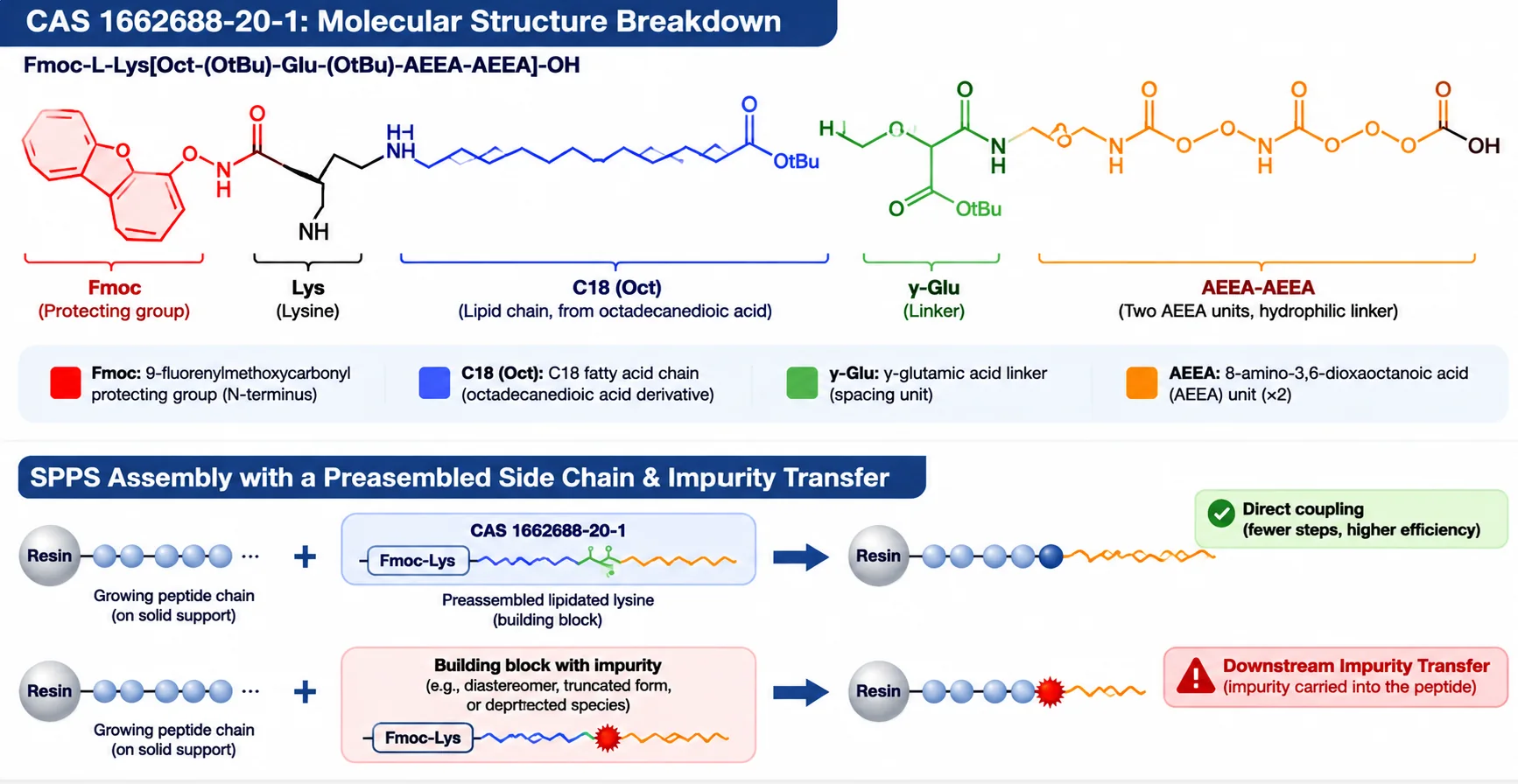
Impurity Transfer and Downstream Process Risks
Impurities in a lipidated lysine building block may be carried into downstream peptide synthesis, increasing the impurity burden of crude peptide and potentially complicating purification.
Several impurity categories deserve particular attention:
-
Stereochemical impurities: Epimerization or the presence of an unintended stereoisomer may affect the structural integrity of the building block.
-
Incomplete side-chain assembly: Structural analogs containing incomplete AEEA units or other unintended components may introduce related impurities.
-
Protecting-group-related impurities: Incomplete protection or premature deprotection may result in compounds with different reactivity and chromatographic behavior.
-
Process-related impurities: Residual reagents, solvents, and other synthesis-related impurities may affect the overall quality profile.
The impact of these impurities depends on their chemical identity, concentration, reactivity, and behavior during downstream processing. They do not necessarily lead to unacceptable API quality, but they can increase the analytical and purification burden.
For this reason, evaluating the impurity profile of CAS 1662688-20-1 is an important part of raw material qualification.
How to Evaluate a CAS 1662688-20-1 Supplier?
Finding a reliable Fmoc-Lys building block manufacturer requires more than checking whether a supplier has the product in its catalog.
For a structurally complex peptide intermediate, buyers should assess the supplier's actual manufacturing capabilities, supply chain transparency, and ability to maintain consistent quality.
1. Manufacturing Capabilities and Supply Chain Transparency
Determine whether the supplier manufactures the building block in-house or sources it from another manufacturer.
For key structural components such as AEEA linkers and C18 fatty acid derivatives, buyers should understand their sourcing arrangements and the level of quality control applied throughout the supply chain.
A supplier's manufacturing status alone does not establish product quality. Distributors can also provide qualified materials when appropriate supplier qualification, traceability, and quality management systems are in place.
The key is to understand who manufactures the product, how its quality is controlled, and how changes in the supply chain are managed.
2. Scale-Up Experience and Batch Consistency
Laboratory-scale synthesis does not automatically demonstrate reliable manufacturing performance at larger production scales.
Buyers should evaluate whether the supplier has experience producing the intermediate at a scale relevant to their intended purchasing volume.
Request representative batch-specific analytical data and, where available, information on process consistency across multiple production batches.
For larger projects, the supplier should also be able to explain its production capacity, purification approach, and supply planning.
3. Customized Specifications and Technical Support
Different peptide synthesis routes may require specific protecting-group configurations, purity requirements, or impurity limits.
A supplier with relevant synthesis capabilities should be able to assess whether customized specifications or alternative building block structures are technically feasible.
Technical communication is particularly important when a customer needs a specific material configuration or requires additional analytical support during process development.
CAS 1662688-20-1 COA and Specifications: What Should Buyers Check?
A CAS 1662688-20-1 specification should clearly define the required identity, assay or purity criteria, related impurity limits, and applicable analytical methods.
A Certificate of Analysis (COA) is an important part of supplier qualification, but an HPLC purity result alone does not provide a complete picture of product quality.
For CAS 1662688-20-1, buyers should consider the following analytical attributes.
1. Chromatographic Purity and Analytical Method
HPLC purity should be evaluated together with the analytical method used to generate the result.
Buyers should review the chromatographic conditions, including the column, mobile phase, gradient, and detection method, to determine whether the method is suitable for separating the target compound from relevant related impurities.
A reported purity value of 99% is meaningful only when supported by an appropriate analytical method.
2. Stereochemical Integrity
The lysine residue contains a defined chiral center, making stereochemical integrity an important quality attribute.
Buyers should assess the potential for epimerization during synthesis and determine whether additional stereochemical characterization is warranted.
Depending on the product specification and quality risk assessment, suppliers may be asked to provide validated chiral chromatographic data or other appropriate evidence of stereochemical identity.
3. Structural Confirmation
Mass spectrometry (MS) and nuclear magnetic resonance (NMR) provide complementary information for confirming molecular identity and structural integrity.
MS helps verify the expected molecular mass, while NMR can provide additional structural information, including evidence of the expected functional groups and protecting-group configuration.
These methods are particularly useful when evaluating structurally complex intermediates with multiple protecting groups.
4. Storage and Shipping Conditions
Storage and shipping requirements should be evaluated separately.
Some published product specifications recommend long-term storage at -20°C. However, the recommended shipping temperature does not necessarily need to match the long-term storage temperature. Some suppliers specify refrigerated shipping with wet ice for domestic shipments.
Buyers should confirm the supplier's written recommendations regarding:
-
Long-term storage temperature.
-
Shipping temperature range.
-
Light and moisture protection.
-
Packaging integrity.
-
Available stability data and temperature-excursion procedures.
Any deviation during transportation should be assessed against the product's documented stability requirements rather than rejected solely because a particular type of coolant was not used.
JunTai's Peptide Intermediate Manufacturing and Customization Capabilities
Shandong Juntai Pharmaceutical Co., Ltd. focuses on peptide intermediates, lipidated amino acid building blocks, and custom synthesis for pharmaceutical research and industrial manufacturing.
For buyers evaluating a CAS 1662688-20-1 manufacturer, Juntai provides product information, batch-specific analytical documentation, and technical communication for customized peptide intermediate requirements.
Our product portfolio includes CAS 1662688-20-1 and related semaglutide side-chain intermediates, including CAS 1118767-16-0 and CAS 1169630-40-3.
Supported by our peptide modifier and small-molecule synthesis platforms, Juntai provides manufacturing and customization support for selected AEEA-containing structures and lipidated intermediates.
For customers evaluating CAS 1662688-20-1, we can support product qualification discussions covering:
-
Chemical identity and product specifications.
-
Batch-specific analytical documentation.
-
Relevant chromatographic and structural characterization data.
-
Customized synthesis requirements.
-
Packaging and supply arrangements.
The scope of analytical documentation and customization support can be discussed according to the target specifications and project requirements.
Our objective is to provide reliable peptide intermediate sourcing options and technical support for customers developing and manufacturing peptide-related products.

Frequently Asked Questions (FAQ)
Q1: What is CAS 1662688-20-1 used for in semaglutide synthesis?
CAS 1662688-20-1 is a preassembled lipidated lysine building block used in certain semaglutide SPPS strategies. It contains a C18 fatty acid-derived moiety, a γ-Glu linker, and two AEEA units, allowing the corresponding side-chain structure to be introduced into the peptide sequence.
Q2: What analytical data should buyers request for CAS 1662688-20-1?
In addition to HPLC purity, buyers should review molecular identity and related impurity data. MS and NMR can provide complementary structural confirmation, while stereochemical analysis may be appropriate depending on the product specification and quality risk assessment.
Q3: How should Fmoc-protected lipidated lysine building blocks be stored?
Storage conditions should follow the supplier's product-specific recommendations. Long-term storage may require -20°C conditions, together with appropriate protection from moisture and light. Shipping conditions should be confirmed separately based on documented stability and packaging requirements.
Q4: What is the difference between CAS 1662688-20-1 and CAS 1118767-16-0?
Both compounds are associated with semaglutide side-chain synthesis, but they have different structural configurations and protecting-group arrangements. CAS 1662688-20-1 is an Fmoc-protected, preassembled lipidated lysine building block, whereas CAS 1118767-16-0 is a differently protected side-chain intermediate. Their suitability depends on the intended synthesis route.
Q5: Can suppliers provide customized specifications for peptide building blocks?
Suppliers with relevant synthesis and analytical capabilities may be able to provide customized specifications or develop alternative building block structures. Feasibility depends on the target chemical structure, required quality attributes, and manufacturing conditions. Buyers should discuss these requirements with the supplier before placing an order.
Related Products
For additional information on semaglutide-related side-chain intermediates and raw materials, please refer to the following products:
For product specifications, analytical documentation, or custom synthesis inquiries, contact the Juntai team.
For further manufacturing, R&D and industrial use only. Not for direct human use.


