
![Fmoc-L-Lys[C20-OtBu-γ-Glu(OtBu)-AEEA-AEEA]-OH](/upload/2026/7/89-1.jpg "Fmoc-L-Lys[C20-OtBu-γ-Glu(OtBu)-AEEA-AEEA]-OH")
How to Evaluate Octadecanedioic Acid Quality | CAS 871-70-5
2026.08.20
Selecting an Octadecanedioic Acid supplier involves more than comparing a product name and a stated purity value. For R&D, process development, and manufacturing projects, the material needs to match the required chemical identity, specification, analytical criteria, documentation, and supply conditions.
Octadecanedioic Acid is identified by CAS 871-70-5 and has the molecular formula C18H34O4. It is also known as 1,18-Octadecanedioic Acid. These identifiers should be confirmed before comparing specifications from different sources.
For buyers evaluating the material for a defined project, the more useful question is not simply “Which supplier has the highest purity?” It is:
“Does the material and its supporting documentation meet the requirements of the intended process?”
1. Confirm the Exact Chemical Identity First
Before reviewing price, packaging, or lead time, confirm that the material being offered is the exact compound required by the project.
For Octadecanedioic Acid, the basic identity information includes:
| Item | Information |
|---|---|
| Product Name | Octadecanedioic Acid |
| CAS Number | 871-70-5 |
| Alternative Name | 1,18-Octadecanedioic Acid |
| Molecular Formula | C18H34O4 |
| Molecular Weight | Approximately 314.46 g/mol |
| Chemical Class | Long-chain α,ω-dicarboxylic acid |
CAS number, molecular formula, and structural representation should be considered together. This is particularly important when a project involves several long-chain dicarboxylic acids or protected derivatives.
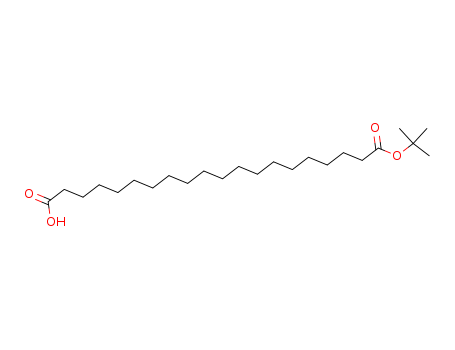
A C18 diacid, a C20 diacid, and a mono-protected C18 derivative may share similar terminology but represent different chemical entities.When evaluating materials with similar long-chain structures, buyers should also confirm the carbon-chain length and exact chemical identity. For a detailed comparison of C18 and C20 dicarboxylic acids, see [Octadecanedioic Acid vs Eicosanedioic Acid].
For the broader structure, applications, and chemical characteristics of CAS 871-70-5, see the Juntai guide to Octadecanedioic Acid.
2. Do Not Compare Suppliers by Purity Alone
Purity is one of the first numbers buyers see on a product page, but it is not sufficient for a technical supplier comparison.
A stated value such as 98% or 99% only becomes meaningful when the analytical method, specification, and batch result are understood.
When comparing Octadecanedioic Acid suppliers, ask:
- What does the stated purity value represent?
- Which analytical method is used?
- Is the value a product specification or an actual batch result?
- Are individual and total impurities controlled?
- Are additional quality parameters relevant to the intended application?
- Can the supplier provide the corresponding analytical documentation?
Publicly available commercial listings illustrate why this distinction matters. Different suppliers may report different purity values and analytical approaches for the same CAS number, while some provide lot-specific COA access.
The comparison should therefore be based on the complete quality package rather than the largest percentage printed in a catalog.
3. Review the Batch-Specific COA
A Certificate of Analysis is more useful when it contains actual results for a defined production batch.
For an Octadecanedioic Acid project, a buyer may need to review:
| Quality Item | What to Check |
|---|---|
| Appearance | Whether the observed form and appearance meet the specification |
| Identification | Whether the analytical result confirms the intended compound |
| Purity | Reported result, specification, and analytical method |
| Individual impurities | Applicable limits and actual batch results |
| Total impurities | Overall impurity limit and batch result |
| Loss on drying or moisture | Applicable test method and acceptance limit |
| Residue on ignition | Whether an inorganic-residue limit is relevant |
| Batch information | Batch number, test date, and document traceability |
Not every project requires the same testing package. The appropriate COA should reflect the material specification and the downstream process.
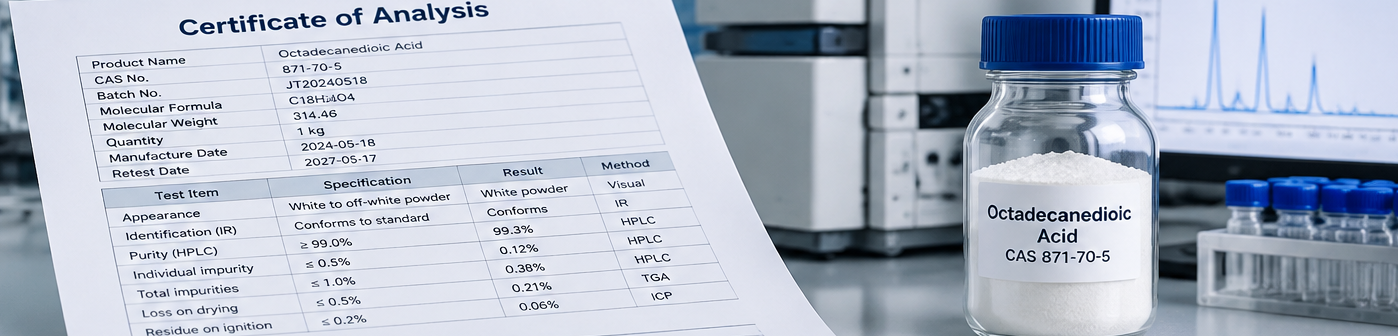
Juntai's current Octadecanedioic Acid specification includes appearance, identification, loss on drying, residue on ignition, individual impurity, and total impurity controls, with actual batch results reported in the corresponding COA.
This type of information gives a technical buyer something more useful than a catalog purity claim: evidence that a specific batch has been evaluated against defined criteria.
4. Compare the Supplier's Specification With Your Own Acceptance Criteria
A supplier's specification and a buyer's internal specification do not necessarily need to be identical.
The key question is whether the supplied material can satisfy the acceptance criteria required by the project.
For example, an R&D team may initially require confirmation of identity and purity. A process-development project may additionally require tighter control of specific impurities or moisture. A repeated manufacturing program may place greater emphasis on batch-to-batch consistency and documentation continuity.
A practical evaluation can be organized as:
Project requirement
→ Supplier specification
→ Batch analytical result
→ Internal acceptance criteria
If any of these four elements is unclear, the material should not be evaluated solely on its catalog description.
5. Check Batch-to-Batch Consistency
One acceptable batch does not automatically establish long-term supply reliability.
This distinction becomes more important when a project moves from initial laboratory work to process development or repeated production studies.
Buyers should ask how the supplier manages:
- raw-material and process consistency;
- established product specifications;
- batch testing;
- impurity control;
- changes to analytical methods;
- repeat-order quality;
- documentation for subsequent batches.

The goal is not to require every batch to produce exactly the same analytical numbers. Normal analytical variation can occur.
The more useful question is whether repeated batches remain within the agreed specification and whether changes that could affect the project are appropriately controlled and communicated.
6. Confirm the Functional State Before Ordering
Chemical identity is only one part of intermediate selection.
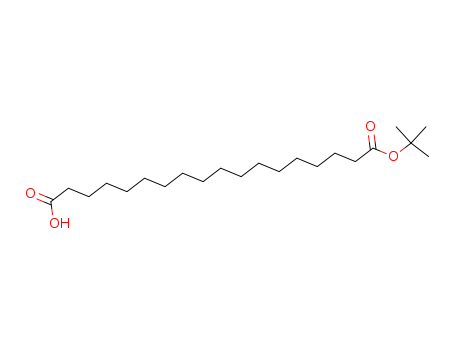
Octadecanedioic Acid contains two free terminal carboxylic acid groups. A protected derivative such as Octadecanedioic Acid Mono-tert-butyl Ester has a different functional-group arrangement and therefore serves a different role in multistep synthesis.
For example:
Octadecanedioic Acid
→ two free carboxyl groups
Octadecanedioic Acid Mono-tert-butyl Ester
→ one free carboxyl group + one protected carboxyl group
These materials should not be treated as interchangeable simply because they share the same C18 framework.
For projects involving protected C18 intermediates, see the related Octadecanedioic Acid Mono-tert-butyl Ester product information.
7. Consider Route Compatibility in Peptide-Related Research
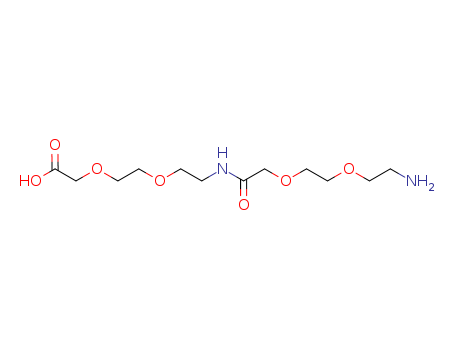
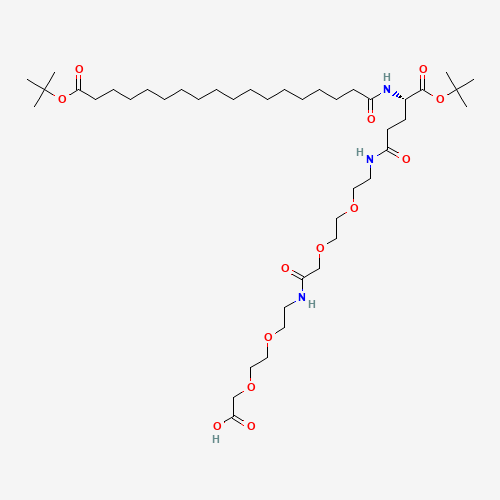
Octadecanedioic Acid can also be relevant to peptide-related side-chain development. In Semaglutide, the C18 diacid component forms part of a larger lipid–linker architecture rather than representing the complete side chain.
For this type of project, procurement teams should confirm more than the carbon-chain length. The required functional state, protection pattern, and downstream coupling strategy also need to match the intended synthesis route.
An unprotected C18 diacid, a mono-protected C18 derivative, and a more advanced linker-containing side-chain intermediate represent different stages of molecular assembly.
This distinction is especially important when purchasing materials for an established synthetic route. A chemically related product may still be unsuitable if its protection state or functional-group arrangement does not match the process.
For a detailed comparison of different Semaglutide-related side-chain intermediates, see How Do Semaglutide Side-Chain Intermediates Differ?
8. Evaluate Documentation and Traceability
For international B2B sourcing, technical documentation can affect project efficiency as much as the material itself.
Before placing an order, buyers may need to confirm the availability of:
- product specification;
- batch-specific COA;
- SDS;
- analytical information;
- packaging information;
- storage requirements;
- other project-specific quality documents.
Document version and batch traceability also matter when materials are used repeatedly.
A supplier that can clearly identify the applicable specification and provide corresponding batch documentation makes technical review easier and reduces uncertainty during incoming-material evaluation.
9. Confirm Supply Conditions Before the Project Expands
Supply requirements often change as a project progresses.
A laboratory may initially need a small research quantity, while a later process-development stage may require larger quantities, different packaging, or repeat batches.
A supplier evaluation should therefore include:
| Supply Factor | What to Confirm |
|---|---|
| Quantity | Research-scale and larger project requirements |
| MOQ | Minimum quantity for the required specification |
| Availability | Current batch or production availability |
| Packaging | Suitable unit and outer packaging |
| Lead Time | Expected preparation and delivery timeline |
| Repeat Supply | Ability to support subsequent batches |
| Documentation | Documents available for each applicable batch |
The objective is not simply to find the supplier offering the largest nominal capacity. It is to determine whether quality, documentation, and supply arrangements can support the expected development path.
10. A Practical Octadecanedioic Acid Supplier Evaluation Checklist
Before selecting an Octadecanedioic Acid supplier, a technical procurement team can use the following checklist:
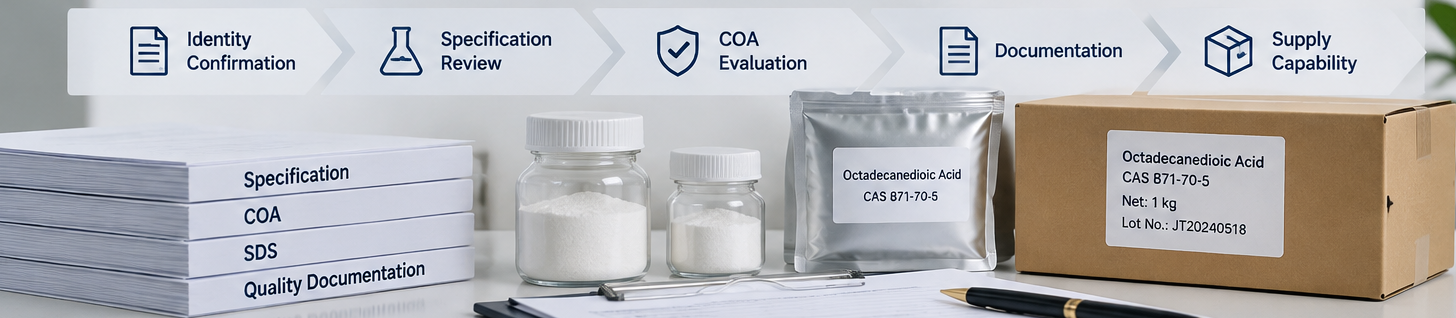
| Evaluation Area | Key Question |
|---|---|
| Chemical Identity | Is CAS 871-70-5 clearly confirmed? |
| Structure | Does the material match the required C18 diacid structure? |
| Functional State | Are both carboxyl groups free, or is a protected derivative required? |
| Purity | What is the specification and analytical method? |
| Impurities | Are individual and total impurity limits defined? |
| COA | Is batch-specific analytical data available? |
| Consistency | Can repeat batches be supplied against the same specification? |
| Documentation | Are specification, COA, SDS, and other required documents available? |
| Packaging | Can the material be packaged appropriately for the project? |
| Supply | Can the supplier support the expected quantity and timeline? |
| Technical Support | Can route-specific or specification-related questions be addressed clearly? |
This checklist can be used before sample evaluation, initial procurement, and long-term supplier qualification.
Frequently Asked Questions
What should I ask an Octadecanedioic Acid supplier before ordering?
Confirm the CAS number, molecular structure, specification, analytical method, batch-specific COA, impurity requirements, packaging, quantity, lead time, and any project-specific documentation requirements.
Is 99% purity automatically better than 98% purity?
Not necessarily. Purity values should be interpreted together with the analytical method, specification, impurity profile, and intended application. Two percentage values obtained using different analytical approaches should not be treated as directly equivalent.
What should an Octadecanedioic Acid COA contain?
The exact COA format depends on the supplier and specification. For technical evaluation, buyers commonly review product identity, batch number, appearance, purity or assay, applicable impurity controls, relevant physical or chemical tests, acceptance criteria, actual results, and traceability information.
How should I compare two Octadecanedioic Acid suppliers?
Compare the complete supply package rather than price or purity alone. Chemical identity, analytical specification, batch data, documentation, consistency, packaging, lead time, and technical communication should all be considered.
Does Octadecanedioic Acid have to be protected before peptide-related use?
That depends on the synthesis route. Unprotected Octadecanedioic Acid and protected C18 derivatives have different functional-group states and may be used at different stages of side-chain development. The appropriate material should be selected according to the target structure and coupling strategy.
Selecting an Octadecanedioic Acid Supplier for Technical Projects
A reliable Octadecanedioic Acid sourcing decision starts with the exact project requirement.
CAS 871-70-5, chemical structure, specification, analytical method, batch results, impurity controls, documentation, and supply conditions should be evaluated as one package.
For R&D and process-development projects, the most useful supplier is not necessarily the one with the highest advertised purity or the largest catalog. The better choice is the source that can provide the required material in the required functional state, support it with appropriate analytical documentation, and maintain the agreed quality criteria as the project develops.
Shandong Juntai Pharmaceutical provides Octadecanedioic Acid (CAS 871-70-5) with a defined product specification and batch-specific quality documentation. Project discussions can cover quantity, packaging, COA requirements, and other technical specifications according to the intended application.


