
![Fmoc-L-Lys[C20-OtBu-γ-Glu(OtBu)-AEEA-AEEA]-OH](/upload/2026/7/89-1.jpg "Fmoc-L-Lys[C20-OtBu-γ-Glu(OtBu)-AEEA-AEEA]-OH")
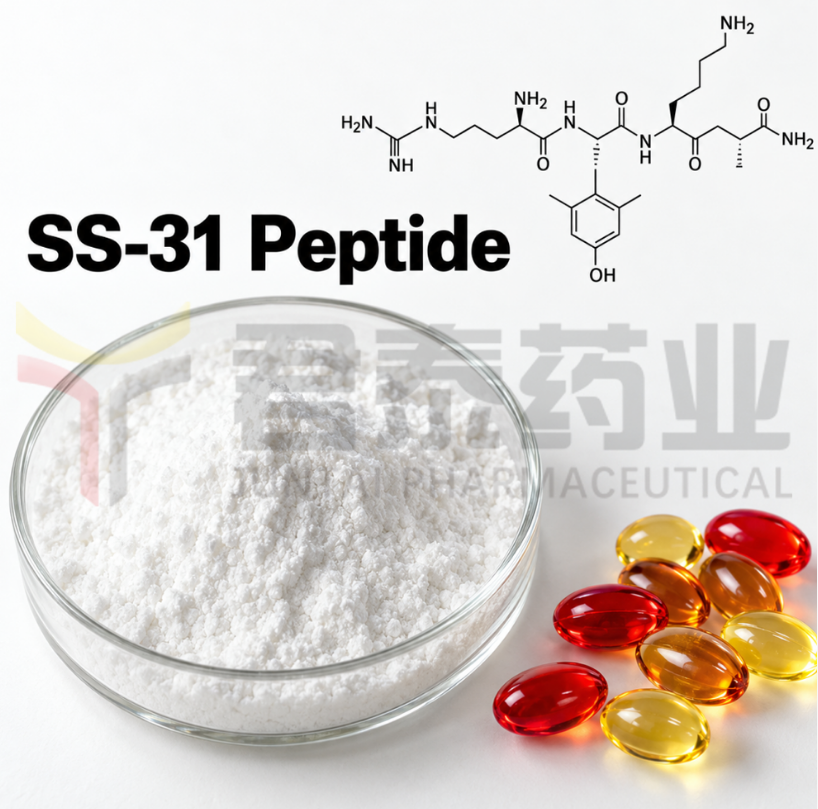
Product Details
CasNo: /
Molecular Formula: C32H49N9O5
Product Overview
SS-31 is a synthetic aromatic-cationic tetrapeptide also described in scientific literature under names including Elamipretide and MTP-131.
Its amino acid sequence is:
D-Arg-Dmt-Lys-Phe-NH2
Dmt refers to 2',6'-dimethyltyrosine. The peptide combines D-arginine, Dmt, lysine, phenylalanine, and a C-terminal amide within a compact four-residue structure.
The combination of positively charged residues and aromatic side chains gives SS-31 distinctive molecular characteristics. In basic research, it has been widely investigated in connection with mitochondrial membrane environments, cardiolipin interactions, peptide–lipid recognition, and structure–function relationships of short modified peptides.
This page provides scientific information about the molecular structure, mitochondrial research background, and analytical characterization of SS-31.
Molecular and Structural Information
| Item | Information |
|---|---|
| Name | SS-31 |
| Common Research Names | Elamipretide, MTP-131 |
| Peptide Type | Aromatic-cationic tetrapeptide |
| Peptide Length | 4 amino acid residues |
| Amino Acid Sequence | D-Arg-Dmt-Lys-Phe-NH2 |
| Dmt | 2',6'-Dimethyltyrosine |
| Molecular Formula | C32H49N9O5 |
| Molecular Weight | Approx. 639.8 g/mol |
| C-Terminus | Amidated |
| Structural Features | D-amino acid, aromatic side chains, cationic residues and C-terminal amidation |
| Research Context | Mitochondrial membrane, cardiolipin, peptide–lipid interaction and short-peptide structure research |
Structural Features
Compact Tetrapeptide Framework
SS-31 contains only four amino acid residues, but its molecular architecture includes several structurally distinct elements.
D-Arg and Lys contribute positively charged side chains, while Dmt and Phe introduce aromatic and hydrophobic characteristics.
The combination of these features within a short peptide sequence makes SS-31 a useful molecular model for studying peptide recognition, membrane-associated behavior, and structure–function relationships.
D-Arg Stereochemistry
The N-terminal residue of SS-31 is D-arginine.
D-amino acids differ stereochemically from the L-amino acids more commonly found in natural proteins. This difference provides a useful basis for examining how amino acid configuration can influence peptide conformation, molecular recognition, and intermolecular interactions.
Dmt Aromatic Residue
Dmt is the abbreviation for 2',6'-dimethyltyrosine.
Compared with conventional tyrosine, Dmt contains two additional methyl substituents on the aromatic ring. These modifications alter its steric and hydrophobic properties.
Together with phenylalanine, Dmt contributes to the aromatic character of SS-31 and is an important structural element in research involving peptide interactions with lipid environments.
C-Terminal Amidation
SS-31 terminates with:
Phe-NH2
This C-terminal amidation changes the charge and local chemical environment of the peptide terminus.
The modification should therefore be considered when interpreting molecular structure, mass spectrometric data, and comparisons between different peptide forms.
Mitochondrial Research Background
Mitochondrial Inner Membrane Research
SS-31 is frequently studied in the context of mitochondrial membrane biology.
The mitochondrial inner membrane has a specialized lipid composition and molecular organization that differs from many other cellular membranes. Cardiolipin is one of its most characteristic phospholipid components.
Research involving SS-31 commonly examines:
- Peptide behavior within mitochondrial membrane environments
- Peptide interactions with membrane lipids
- The influence of charge and aromatic residues on lipid recognition
- Membrane-dependent peptide behavior
- Relationships between mitochondrial membrane structure and molecular function
These topics primarily belong to mitochondrial biology, biophysics, and peptide chemistry research.
Cardiolipin Interaction Research
What Is Cardiolipin?
Cardiolipin is a distinctive phospholipid strongly associated with the mitochondrial inner membrane.
Its unusual molecular structure and localization make it an important subject in studies of membrane organization, lipid–protein interactions, and mitochondrial structural biology.
SS-31 and Cardiolipin
SS-31 is frequently discussed in scientific studies involving cardiolipin interaction.
Research commonly focuses on:
- Peptide–cardiolipin interaction
- Peptide–lipid molecular recognition
- The role of aromatic residues in lipid environments
- The influence of cationic residues on negatively charged membrane components
- Peptide behavior in membrane-associated states
These studies help clarify how short peptides interact with specialized membrane lipids at the molecular level.
Peptide–Lipid Interaction
The combination of positively charged residues and aromatic side chains makes SS-31 useful as a model for peptide–lipid interaction research.
A common research framework can be summarized as:
Peptide structure → lipid recognition → molecular behavior in membrane environments
This relationship is also relevant to the broader study of short peptides with defined charge distribution and aromatic structural features.
Mitochondrial Structure and Molecular Behavior
Mitochondrial research involves more than individual proteins or lipids. It also considers the relationships among membrane composition, protein complexes, lipid organization, and energy-related molecular systems.
SS-31-related research may involve:
- Mitochondrial membrane biology
- Cardiolipin-related studies
- Mitochondrial membrane organization
- Peptide–lipid interactions
- Mitochondrial structural biology
- Short-peptide behavior in membrane environments
Such research may be conducted using biochemical systems, cellular models, membrane-mimetic platforms, or other controlled experimental settings.
Results obtained from different experimental models should be interpreted according to the specific study conditions and should not be directly extrapolated to clinical conclusions.
Structure–Function Relationship Studies
Although SS-31 is a short peptide, it contains several structural elements of interest:
- D-Arg
- Dmt
- Lys
- Phe
- Cationic residues
- Aromatic side chains
- C-terminal amidation
These features make SS-31 suitable for short-peptide structure–function studies.
Research may compare changes in:
- D- versus L-amino acid configuration
- Aromatic residue composition
- Charge distribution
- Hydrophobicity
- C-terminal structure
- Individual amino acid substitutions
Such comparisons can help clarify how peptide sequence, stereochemistry, side-chain properties, and terminal modifications influence molecular recognition and membrane interaction.
SS-31 and Different Molecular Forms
In scientific literature and chemical databases, SS-31, Elamipretide, and related salt forms may be described using different molecular forms.
Free peptide, salt forms, and formulation-related forms can differ in:
- Molecular composition
- Molecular weight
- Ionic state
- Analytical results
- Chromatographic behavior
For this reason, molecular identity should not be determined from the name alone.
A more reliable comparison should consider:
- Amino acid sequence
- Molecular formula
- Molecular weight
- C-terminal modification
- Salt form
- Analytical data
This helps prevent confusion between related but chemically distinct forms.
Analytical and Structural Characterization
SS-31 can be investigated using established analytical methods for peptide identity and structural characterization.
Common approaches include:
- High-performance liquid chromatography (HPLC)
- Mass spectrometry (MS)
- LC-MS analysis
- Molecular-weight verification
- Amino acid sequence analysis
- Peptide mapping
- Terminal modification analysis
- Structure-related characterization
HPLC can be used to examine major peptide components and related chromatographic peaks.
MS and LC-MS can provide molecular-mass information and support structural identity assessment.
Because SS-31 contains D-Arg, Dmt, and a C-terminal amide, analytical data should be interpreted in the context of the complete molecular structure rather than relying on the peptide name alone.
Frequently Asked Questions
What type of peptide is SS-31?
SS-31 is a four-residue aromatic-cationic peptide commonly studied in mitochondrial membrane, cardiolipin, and peptide–lipid interaction research.
What is the amino acid sequence of SS-31?
The sequence is:
D-Arg-Dmt-Lys-Phe-NH2
Dmt refers to 2',6'-dimethyltyrosine.
What does Dmt mean in SS-31?
Dmt stands for 2',6'-dimethyltyrosine, a modified aromatic amino acid containing two methyl substituents on the tyrosine aromatic ring.
Why is SS-31 described as an aromatic-cationic peptide?
Its structure contains positively charged residues such as D-Arg and Lys together with aromatic residues including Dmt and Phe.
Why is SS-31 studied in cardiolipin-related research?
Its charge distribution and aromatic structural features make it useful as a model for studying molecular interactions between short peptides and cardiolipin or other membrane lipids.
Are SS-31 and Elamipretide the same?
SS-31 and Elamipretide are commonly used in scientific literature to describe the same core tetrapeptide-related molecular structure. However, specific studies may involve different salt forms or molecular forms, so molecular formula, molecular weight, sequence, and analytical information should also be checked.
Which analytical techniques are commonly used to study SS-31?
Common techniques include HPLC, MS, LC-MS, molecular-weight verification, sequence analysis, peptide mapping, and terminal modification analysis.
Relevant Products
-
 Fmoc-Glu(OtBu)-Gly-Gly-OH
CAS:N/A
-
 LL-37
LL-37CAS:/
-
 Thymosin Beta-4
CAS:/


