
How Do Semaglutide Side-Chain Intermediates Differ? CAS 1662688-20-1 vs 1118767-16-0 vs 1169630-40-3
2026.09.04
Semaglutide side-chain intermediates are often grouped under the same commercial description, although their chemical structures and intended roles in peptide synthesis can differ substantially.
Three examples are CAS 1662688-20-1, 1118767-16-0 and 1169630-40-3. Each incorporates structural elements associated with the C18 lipid side chain of Semaglutide, including a glutamic acid-derived unit and two AEEA linker units. They differ in whether lysine has already been incorporated, which carboxyl groups remain protected, and whether the terminal functional group has been activated for coupling.
These distinctions matter in both synthetic route development and intermediate sourcing. A material that is suitable for one assembly strategy cannot automatically replace another simply because the compounds share the same lipid-linker framework.
1. Comparing the Three Semaglutide Side-Chain Intermediates
The most useful starting point is to compare their molecular structures rather than treating the three CAS numbers as alternative names for the same material.
|
CAS Number |
Structural Form |
Key Distinction |
Potential Role |
|---|---|---|---|
| 1662688-20-1 | Fmoc-protected lysine bearing an assembled C18–γ-Glu–AEEA-AEEA side chain | Lipid side chain is already attached to lysine | Preassembled lipidated lysine building block |
| 1118767-16-0 | Separate C18–γ-Glu–AEEA-AEEA fragment with tert-butyl ester protection | Contains a free terminal carboxylic acid but no Fmoc-Lys | Protected side-chain fragment for further processing |
| 1169630-40-3 | Side-chain derivative with an OSu-activated terminal ester and unprotected acid groups | Contains an activated ester rather than the protected free-acid arrangement of 1118767-16-0 | Activated side-chain intermediate for a compatible coupling route |
These are distinct chemical entities, not interchangeable grades of a single intermediate.
The protected side-chain fragment, activated side-chain derivative and lipidated lysine building block can be relevant to different manufacturing strategies. Their suitability depends on the route architecture, reaction partners and required protection-group configuration.
2. Understanding the Structural Differences
CAS 1662688-20-1: Preassembled Lipidated Lysine Building Block
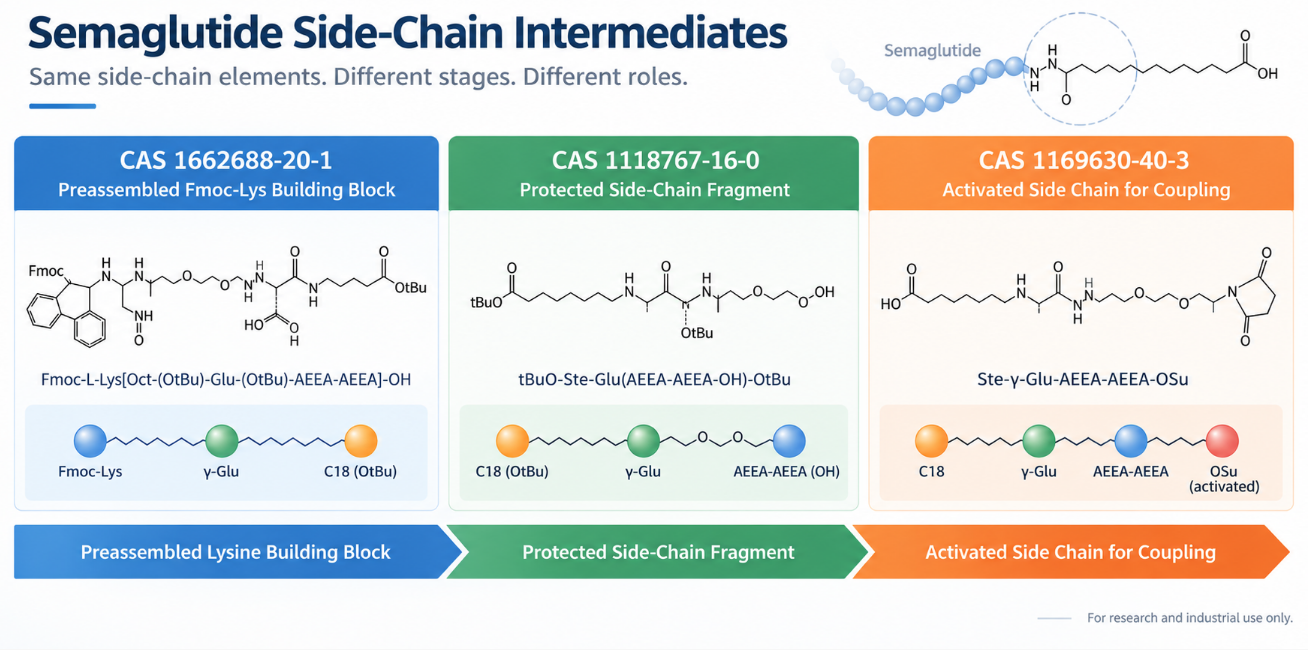
Fmoc-L-Lys[Oct-(OtBu)-Glu-(OtBu)-AEEA-AEEA]-OH (CAS 1662688-20-1) contains an Fmoc-protected lysine residue to which the lipid-containing side chain is already attached.
This is its defining structural characteristic. The C18 dicarboxylic-acid-derived segment, glutamate unit and AEEA-AEEA spacer are incorporated into the lysine building block before that building block is used in a suitable peptide assembly route.
The molecule retains the protected functionalities required by its specific synthesis design, together with a free lysine carboxyl group.
For research teams using a building-block-based approach, the relevant questions concern the compatibility of this preassembled structure with the peptide synthesis strategy, its protection state and the analytical controls applied to the complete intermediate.
The presence of Fmoc-Lys distinguishes CAS 1662688-20-1 from the two separate side-chain derivatives discussed below.
CAS 1118767-16-0: Protected Side-Chain Fragment
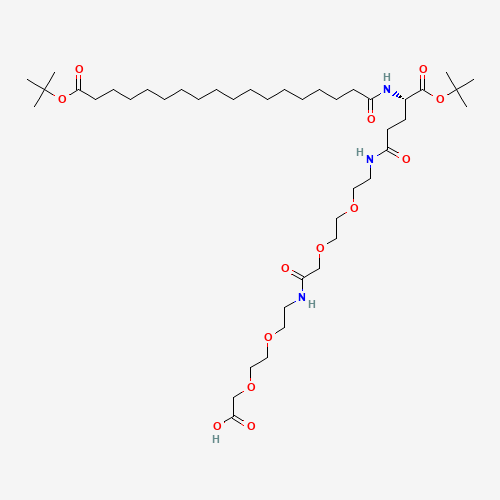
tBuO-Ste-γ-Glu(AEEA-AEEA-OH)-OtBu (CAS 1118767-16-0) contains the assembled lipid–glutamate–linker framework without an attached lysine residue.
The C18-derived segment and glutamic acid unit carry tert-butyl ester protection, while the terminal AEEA-AEEA carboxylic acid remains available for subsequent functional-group transformation or coupling, depending on the chosen route.
This makes CAS 1118767-16-0 a separate protected side-chain intermediate rather than a complete lipidated lysine building block.
Its value in route development lies in the defined structural state of the assembled fragment. Researchers can evaluate the suitability of the intermediate against the functional-group requirements of their subsequent synthesis stages.
The material is therefore chemically related to CAS 1662688-20-1 but cannot be treated as a direct replacement for it. The inclusion of lysine and the resulting molecular structure are fundamentally different.
For product-specific structural information and published quality specifications, see tBuO-Ste-γ-Glu(AEEA-AEEA-OH)-OtBu, CAS 1118767-16-0.
CAS 1169630-40-3: OSu-Activated Side-Chain Derivative
Ste-γ-Glu-AEEA-AEEA-OSu (CAS 1169630-40-3) is distinguished by an activated N-hydroxysuccinimide ester, commonly described as an OSu group.
This functional group is relevant to the formation of an amide bond with a suitable amine-containing reaction partner.
There is also an important protection-state difference between CAS 1169630-40-3 and CAS 1118767-16-0. The former is an unprotected acid-containing activated ester, whereas the latter retains tert-butyl ester protection and a free terminal carboxylic acid.
The distinction extends beyond the presence or absence of an OSu group. Functional-group protection, activation state and compatibility with downstream materials must all be considered.
CAS 1169630-40-3 may be evaluated for routes in which an independently prepared lipid side-chain derivative is coupled to a suitable peptide intermediate at a later stage.
3. How Intermediate Selection Depends on the Synthesis Route
There is no universal sequence in which these three CAS numbers must be used consecutively.
They represent different ways of preparing or introducing a structurally related lipid side chain.
Preassembled Building-Block Strategy
One approach uses a lysine building block that already contains the lipid side chain. CAS 1662688-20-1 represents this structural category.
The relevant process considerations include compatibility with the peptide assembly system, protecting-group requirements and the impurity profile associated with the more highly assembled intermediate.
Separate Side-Chain Coupling Strategy
Another approach prepares the peptide and lipid side-chain components separately before their eventual conjugation.
A protected fragment such as CAS 1118767-16-0 may be considered during side-chain preparation, whereas an activated derivative such as CAS 1169630-40-3 may serve a downstream coupling role.
The two compounds should not be assumed to be connected through a single activation step. Differences in protecting groups and terminal functionality mean that additional chemical transformations may be necessary, depending on the route.
The important decision is not which intermediate is theoretically more advanced. It is which molecular structure matches the point at which the lipid side chain is introduced.
4. What Should R&D and Procurement Teams Verify?
For Semaglutide-related intermediates, procurement specifications should reflect the actual molecular structure and intended technical use.
Confirm Structure and Functional Groups
A CAS number is a useful identification reference, but the complete chemical structure should also be reviewed.
This is particularly important for compounds with similar abbreviated names. A difference in the terminal ester, lysine attachment or protecting groups can change the intended application of the material.
Review Analytical Requirements
HPLC purity alone does not establish full equivalence between different intermediates.
Depending on the material and development stage, relevant evaluation parameters may include identity confirmation, assay, related substances, water content, residual solvents and structural impurities.
The test methods and acceptance criteria should be appropriate to the specific intermediate rather than transferred automatically from another product.
Confirm Documentation and Supply Requirements
Before requesting a quotation or sample, it is useful to provide the target CAS number, required quantity, intended application and specification requirements.
For repeat development work, batch traceability and the availability of suitable analytical documentation can be as important as the initial purity specification.
Where a route-specific material is needed, the requirement should be evaluated as a defined custom synthesis project rather than as a generic Semaglutide intermediate inquiry.
5. Frequently Asked Questions
Are CAS 1662688-20-1 and CAS 1118767-16-0 interchangeable?
No. CAS 1662688-20-1 already contains an Fmoc-protected lysine residue bearing the assembled lipid side chain. CAS 1118767-16-0 is a separate protected side-chain fragment without lysine. Using one in place of the other would require a compatible change in the synthesis strategy.
Is CAS 1169630-40-3 simply the activated form of CAS 1118767-16-0?
Not in the sense of a single functional-group difference. CAS 1169630-40-3 contains an OSu-activated ester and unprotected acid groups, while CAS 1118767-16-0 retains tert-butyl ester protection and a free terminal carboxylic acid. The structural and protection-state differences must be taken into account.
Can the same purity specification be used for all three intermediates?
Not automatically. Analytical requirements depend on the chemical entity, its preparation process and its intended downstream use. Purity results should be interpreted alongside identity, assay, impurity specifications and the relevant test methods.
What information helps a supplier evaluate an intermediate request?
The full chemical name, CAS number, target quantity, required purity or assay, analytical documentation requirements and intended research application provide a practical starting point. A structure drawing is particularly useful when abbreviated chemical names or protection-group conventions might cause ambiguity.
6. Conclusion
CAS 1662688-20-1, 1118767-16-0 and 1169630-40-3 share structural features associated with the Semaglutide lipid side chain, but each represents a distinct intermediate.
CAS 1662688-20-1 contains an already assembled lipidated lysine building block. CAS 1118767-16-0 is a separate protected side-chain fragment, while CAS 1169630-40-3 is an OSu-activated derivative with a different protection state.
For technical sourcing, the decisive factors are molecular identity, functional-group configuration and compatibility with the intended synthesis route. Only after these have been established can the appropriate specifications and supply requirements be evaluated.
Shandong Juntai Pharmaceutical Co., Ltd. supports research and process-development projects involving peptide intermediates, lipid side-chain structures and custom synthesis. Technical discussions may include intermediate selection, analytical documentation and project-specific requirements.
For research, process-development and industrial technical reference only. Not for human or veterinary use.


