
![Fmoc-L-Lys[C20-OtBu-γ-Glu(OtBu)-AEEA-AEEA]-OH](/upload/2026/7/89-1.jpg "Fmoc-L-Lys[C20-OtBu-γ-Glu(OtBu)-AEEA-AEEA]-OH")
Eicosanedioic Acid vs Mono-tert-Butyl Ester: Which C20 Diacid Fits Your Route?
2026.08.24
Eicosanedioic Acid vs Eicosanedioic Acid Mono-tert-Butyl Ester: Which Structure Fits Your Project?
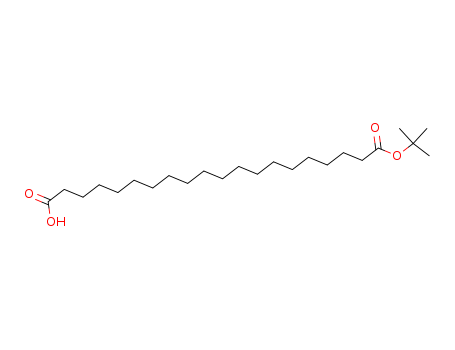
Eicosanedioic Acid and Eicosanedioic Acid Mono-tert-butyl Ester share the same C20 carbon framework, but they are not interchangeable.
The key difference is the state of their terminal carboxyl groups.
PubChem identifies Eicosanedioic Acid as CAS 2424-92-2, formula C₂₀H₃₈O₄ and molecular weight 342.5 g/mol. CAS 683239-16-9, by comparison, is its mono-tert-butyl-protected derivative with formula C₂₄H₄₆O₄ and molecular weight 398.6 g/mol.
Structural Comparison
| Feature | Eicosanedioic Acid | Eicosanedioic Acid Mono-tert-butyl Ester |
|---|---|---|
| CAS No. | 2424-92-2 | 683239-16-9 |
| Carbon Framework | C20 | C20 |
| Free Carboxyl Groups | 2 | 1 |
| tert-Butyl Protected Group | No | Yes |
| Molecular Formula | C₂₀H₃₈O₄ | C₂₄H₄₆O₄ |
| Main Structural Character | Symmetric diacid | Mono-protected diacid |
The choice therefore comes down to the chemistry required at the two ends of the molecule.

When Does Eicosanedioic Acid Make Sense?
The unprotected C20 dicarboxylic acid is useful when both terminal groups need to remain available.
Its symmetric structure can be appropriate for bifunctional chemistry or for projects in which there is no need to distinguish one end from the other at the starting stage.
When Is CAS 683239-16-9 More Suitable?
Eicosanedioic Acid Mono-tert-butyl Ester is more relevant when the route requires sequential functionalization.
One free carboxyl group can participate in further structure development while the opposite end remains protected.
This is the key reason buyers searching 2424-92-2 vs 683239-16-9 should compare protection state rather than simply purity or molecular weight.
What About C18 vs C20 Protected Dicarboxylic Acids?
Chain length introduces another selection question.
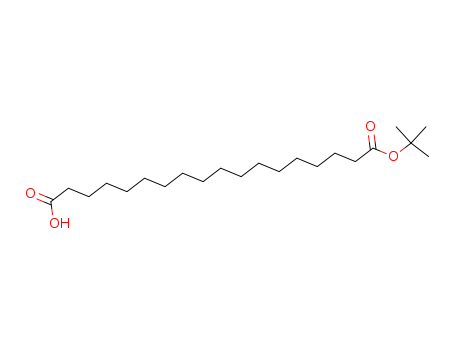
A C18 mono-protected diacid such as 18-(tert-butoxy)-18-oxooctadecanoic acid has a shorter aliphatic framework than CAS 683239-16-9.
For comparison with the unprotected C18 parent diacid, see Octadecanedioic Acid (CAS 871-70-5).
Both follow the same broad design concept—one free acid and one protected terminus—but the distance between the functional ends differs.
A C18 vs C20 protected dicarboxylic acid decision should therefore be driven by the target molecular structure.
Longer does not automatically mean better. If the downstream molecule was designed around a specific chain length, substituting another homologue changes the chemical entity and may change downstream behavior.
Three Questions to Ask Before Selecting
Before choosing either C20 product, clarify:
-
Do both carboxyl groups need to be available at the same stage?
-
Does the route require one terminus to remain protected?
-
Is the target architecture specifically designed around a C18 or C20 chain?
These three questions usually provide more useful guidance than selecting a product by purity alone.
FAQ
Can CAS 2424-92-2 directly replace CAS 683239-16-9?
No. One is an unprotected C20 diacid and the other is a mono-tert-butyl-protected derivative.
Is C20 always preferable to C18?
No. Chain length should match the target structure and downstream chemistry.
For R&D projects, the exact CAS number, carbon-chain length and protection state should all be confirmed before selecting the intermediate.
For research use only.
If the main question is why one terminus is protected in the first place, read Why Mono-tert-Butyl Protection Matters in C20 Dicarboxylic Acid Chemistry.


