
![Fmoc-L-Lys[C20-OtBu-γ-Glu(OtBu)-AEEA-AEEA]-OH](/upload/2026/7/89-1.jpg "Fmoc-L-Lys[C20-OtBu-γ-Glu(OtBu)-AEEA-AEEA]-OH")
C20 Protected Dicarboxylic Acid: Why Mono-tert-Butyl Protection Matters
2026.08.24
Why Mono-tert-Butyl Protection Matters in C20 Dicarboxylic Acid Chemistry
A dicarboxylic acid with two free terminal groups is useful when both ends need to participate in chemistry. It becomes less convenient when a synthesis needs those two ends to be treated differently.
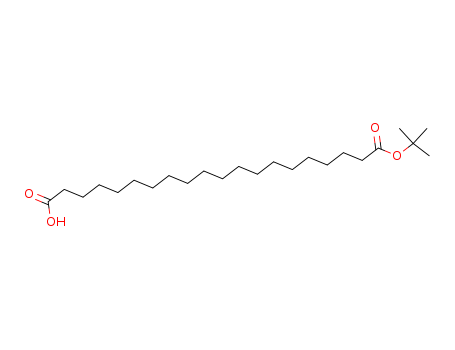
That is the practical reason for using a C20 protected dicarboxylic acid such as 20-(tert-Butoxy)-20-oxoicosanoic acid.
CAS 683239-16-9 contains one free carboxylic acid and one carboxyl group protected as a tert-butyl ester. PubChem confirms its molecular formula as C₂₄H₄₆O₄ and shows the free-acid/tert-butyl-ester arrangement in its canonical structure.
From Symmetric Diacid to Differentiated Intermediate
Eicosanedioic Acid has two free carboxyl groups.
Its mono-tert-butyl ester changes only one end of the molecule, but that change is significant in route design.
The protected structure can be represented conceptually as:
COOH — C20 framework — COOtBu
One terminus remains chemically available while the second is temporarily masked.
This turns a symmetric long-chain diacid into a mono-protected C20 dicarboxylic acid with differentiated ends.
Why Is That Useful?
Consider a route in which the C20 chain needs to be attached to another structural unit at only one terminus.
Starting with two free carboxyl groups may require additional control to avoid undesired reactions at both ends.
With a mono-protected intermediate, the available carboxyl group can be used first. The protected terminus can then be addressed at a later stage when the route requires it.
That is why Eicosanedioic Acid Mono-tert-butyl Ester uses are better understood in terms of route control rather than as a generic list of applications.
Where Does the C20 Chain Fit?
The long aliphatic framework provides a substantial non-polar segment between the two terminal functionalities.For projects comparing different chain lengths, Octadecanedioic Acid (C18) provides a useful reference point alongside the C20 system.
In larger molecular structures, that chain may be used as a long spacer or fatty-diacid segment.
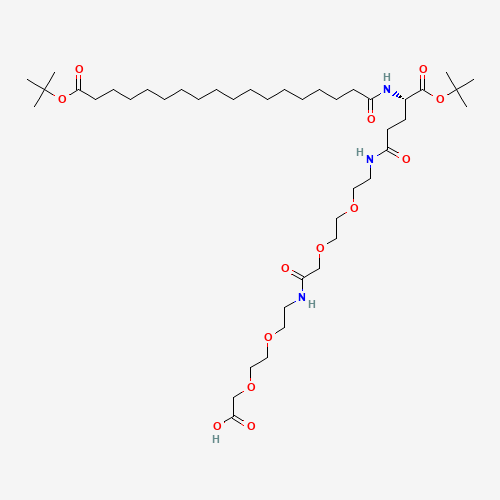
Published patent chemistry also demonstrates the use of CAS 683239-16-9 as a C20 building block in more complex peptide-related side-chain structures.
The exact effect of the C20 segment, however, depends on the complete molecule. It should not be assumed that a longer chain automatically produces a better result.
When Is the Parent Diacid More Appropriate?
Mono-protection is not always required.
If a project needs both terminal carboxyl groups available, Eicosanedioic Acid may be the more logical starting material.
If the route needs controlled sequential functionalization, the C20 fatty diacid intermediate CAS 683239-16-9 may offer a more suitable protection state.
This is why structural requirements should be defined before selecting between the parent diacid and its protected derivative.
FAQ
What does mono-protected C20 dicarboxylic acid mean?
It means one terminal carboxyl group is protected while the other remains free for further chemistry.
Why use a tert-butyl ester?
In this compound, the tert-butyl ester provides a protected terminal carboxyl function that differentiates it from the free carboxyl group at the opposite end.
The most useful way to evaluate CAS 683239-16-9 is therefore as a route-specific functional intermediate, not simply as another long-chain acid.
For research use only.
For a direct comparison of the parent and protected C20 structures, see Eicosanedioic Acid vs Eicosanedioic Acid Mono-tert-Butyl Ester.


