
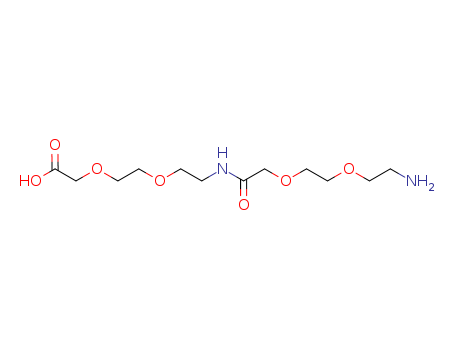
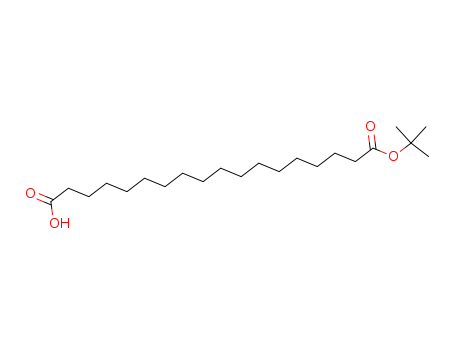
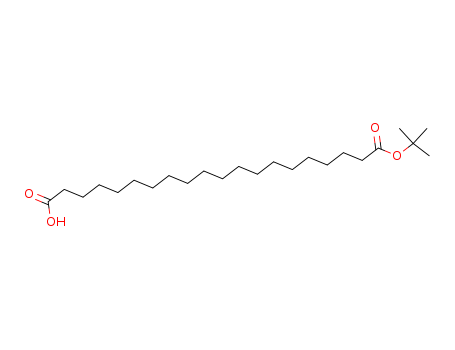
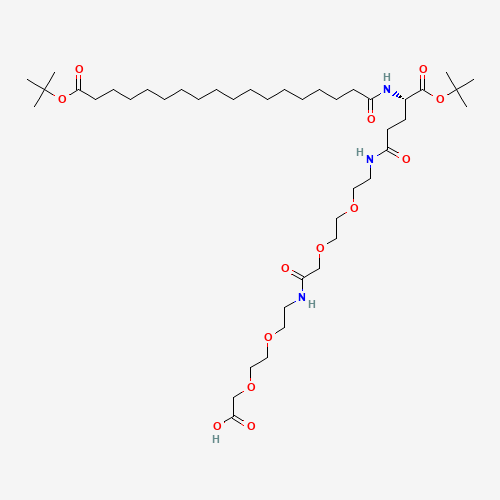
![Fmoc-L-Lys[C20-OtBu-γ-Glu(OtBu)-AEEA-AEEA]-OH](/upload/2026/7/89-1.jpg "Fmoc-L-Lys[C20-OtBu-γ-Glu(OtBu)-AEEA-AEEA]-OH")
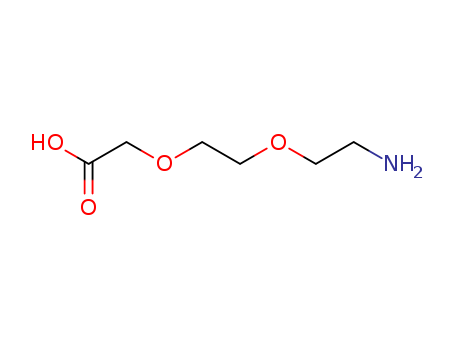
AEEA | CAS 134978-97-5
- cas:134978-97-5
- Molecular Formula:C6H13NO4
- Purity:99%
- Molecular Weight:163.174
Product Details
CasNo: 134978-97-5
Molecular Formula: C6H13NO4
Reputable factory supply AEEA 134978-97-5 in bulk at low price
- Molecular Formula:C6H13NO4
- Molecular Weight:163.174
- Vapor Pressure:5.23E-05mmHg at 25°C
- Melting Point:124.0 to 128.0 °C
- Refractive Index:1.466
- Boiling Point:323.8 °C at 760 mmHg
- PKA:3.37±0.10(Predicted)
- Flash Point:149.6 °C
- PSA:81.78000
- Density:1.177 g/cm3
- LogP:-0.23680
2-(2-(2-Aminoethoxy)ethoxy)acetic acid(Cas 134978-97-5) Usage
InChI:InChI=1/C6H13NO4/c7-1-2-10-3-4-11-5-6(8)9/h1-5,7H2,(H,8,9)
134978-97-5 Relevant articles
Preparation method of AEEA
-
Paragraph 0067-0069, (2021/10/27)
The invention relates to the technical field of chemical synthesis, in particular to a preparation method of AEA. According to the preparation method of AEEA provided by the invention, amino on diglycol amine is protected by chloroacetyl chloride, then ring formation is carried out in the presence of NaH, and AEEA is obtained through hydrolysis. The method has the advantages of reduced reaction steps, low production cost, high product purity and few impurities, and is suitable for industrial large-scale production.
TARGETED BIFUNCTIONAL DEGRADERS
-
Page/Page column 189, (2021/04/17)
The present invention provides, in one aspect, bifunctional compounds that can be used to promote or enhance degradation of certain circulating proteins. In another aspect, the present invention provides bifunctional compounds that can be used to promote or enhance degradation of certain autoantibodies. In certain embodiments, treatment or management of a disease and/or disorder requires degradation, removal, or reduction in concentration of the circulating protein or the autoantibody in the subject. Thus, in certain embodiments, administration of a compound of the invention to the subject removes or reduces the circulation concentration of the circulating protein or the autoantibody, thus treating, ameliorating, or preventing the disease and/or disorder. In certain embodiments, the circulating protein is TNF.
Preparation method of [2-[1-(Fmoc-amino)ethoxy]ethoxy]acetic acid
-
Paragraph 0065; 0068; 0070, (2019/09/17)
The invention provides a preparation method of [2-[1-(Fmoc-amino)ethoxy]ethoxy]acetic acid. The preparation method comprises steps as follows: amino protection is performed on diglycolamine by use ofphthalic anhydride, an obtained intermediate and halo-acetic acid or halo-acetate are subjected to a reaction, deprotection or deprotection and hydrolysis are performed, a product reacts with a Fmoc-based amino protection reagent, and [2-[1-(Fmoc-amino)ethoxy]ethoxy]acetic acid is obtained. In the preparation method, phthalic anhydride and diglycolamine are taken as initial raw materials, short time is required by an amino protection reaction, an obtained intermediate compound has good stability, can be preserved for a long time and does not react with water, water-soluble impurities (such asthe raw material diglycolamine, a byproduct phthalic acid and the like) can be separated through extraction, so that an amino protection product with high purity is obtained, and the purity and the yield of the target product are also improved.
Synthesis, Biological Evaluation of Fluorescent 23-Hydroxybetulinic Acid Probes, and Their Cellular Localization Studies
Yao, Hong,Wei, Guoxiang,Liu, Yanpeng,Yao, Hequan,Zhu, Zheying,Ye, Wencai,Wu, Xiaoming,Xu, Jinyi,Xu, Shengtao
, p. 1030 - 1034 (2018/10/15)
23-Hydroxybetulinic acid (23-HBA) is a complex lupane triterpenoid, which has attracted increasing attention as an anticancer agent. However, its detailed mechanism of anticancer action remains elusive so far. To reveal its anticancer mode of action, a series of fluorescent 23-HBA derivatives conjugated with coumarin dyes were designed, synthesized, and evaluated for their antiproliferative activities. Subcellular localization and uptake profile studies of representative fluorescent 23-HBA probe 26c were performed in B16F10 cells, and the results suggested that probe 26c was rapidly taken up into B10F10 cells in a dose-dependent manner and mitochondrion was the main site of its accumulation. Further mode of action studies implied that the mitochondrial pathway was involved in 23-HBA-mediated apoptosis. Together, our results provided new clues for revealing the molecular mechanism of natural product 23-HBA for its further development into an antitumor agent.
134978-97-5 Process route
-
-
C6H11NO3

-
![[2-(N-2-amino ethoxy)ethoxy] acetic acid](/upload/2026/7/26d2dca0-fe1f-4397-bc25-7bfa7b6d2771.png)
- 134978-97-5,139729-28-5
[2-(N-2-amino ethoxy)ethoxy] acetic acid
| Conditions | Yield |
|---|---|
|
With hydrogenchloride; In water; for 2h; Reflux;
|
92% |
-
![[2-(2-dibenzylaminoethoxy)ethoxy]acetic acid](/upload/2026/7/516f45cb-9d3e-4a15-a41e-df83a7d3280d.png)
- 166108-70-9
[2-(2-dibenzylaminoethoxy)ethoxy]acetic acid
-
- 134978-97-5,139729-28-5
[2-(N-2-amino ethoxy)ethoxy] acetic acid
| Conditions | Yield |
|---|---|
|
With hydrogen; palladium on activated charcoal; In methanol; at 45 ℃; for 20h; under 760 Torr;
|
134978-97-5 Upstream products
-
166108-70-9
[2-(2-dibenzylaminoethoxy)ethoxy]acetic acid
-
166108-71-0
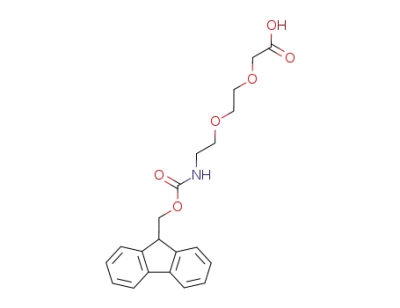
8-(9-fluorenylmethyloxycarbonyl-amino)-3,6-dioxaoctanoic acid
-
882518-90-3
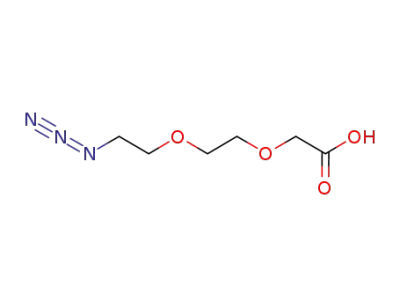
N-(2-(2-(2-azidoethoxy)ethoxy))acetic acid
-
108466-89-3
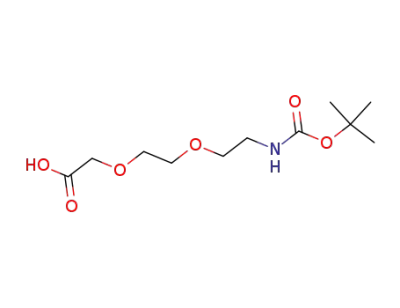
N-(tert-butyloxycarbonyl)-8-amino-3,6-dioxaoctanoic acid
134978-97-5 Downstream products
-
166108-71-0
8-(9-fluorenylmethyloxycarbonyl-amino)-3,6-dioxaoctanoic acid
-
720695-95-4
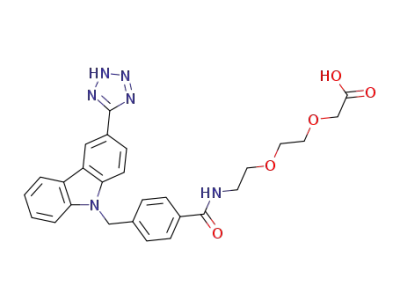
[2-(2-{4-[3-(2H-tetrazol-5-yl)-carbazol-9-ylmethyl]benzoylamino}ethoxy)ethoxy]acetic acid
-
108466-89-3
N-(tert-butyloxycarbonyl)-8-amino-3,6-dioxaoctanoic acid
Relevant Products
-
 Fmoc-Glu(OtBu)-Gly-Gly-OH
CAS:N/A
-
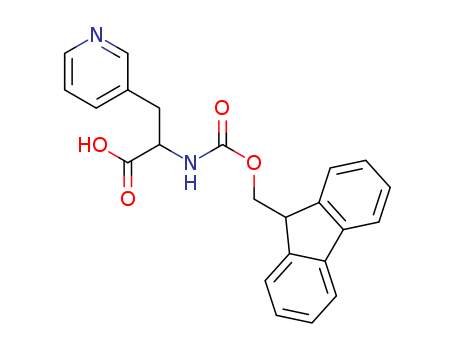 Fmoc-L-3-Pal-OH
CAS:175453-07-3
-
 Fmoc-7-Me-L-Trp-OH
CAS:1808268-53-2


