
![Fmoc-L-Lys[C20-OtBu-γ-Glu(OtBu)-AEEA-AEEA]-OH](/upload/2026/7/89-1.jpg "Fmoc-L-Lys[C20-OtBu-γ-Glu(OtBu)-AEEA-AEEA]-OH")
683239-16-9 COA & Specification: What Technical Buyers Should Check
2026.08.21
683239-16-9 COA and Specification: What Should Technical Buyers Check?
For a specialized intermediate such as 20-(tert-Butoxy)-20-oxoicosanoic acid, a catalog purity number is only the starting point.
A 683239-16-9 COA should help confirm that the actual batch corresponds to the required material and meets the agreed quality specification.
That becomes especially important when the compound is being evaluated for a multistep process rather than a one-off laboratory experiment.
First Check the Product Identity
Before reviewing individual test results, make sure the document refers to the correct chemical entity.
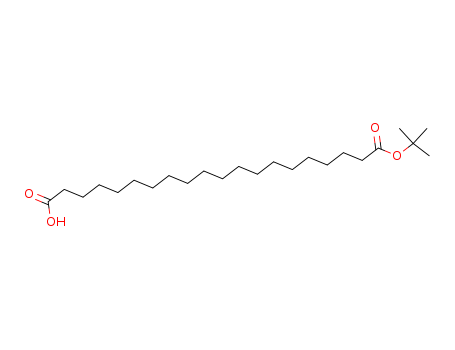
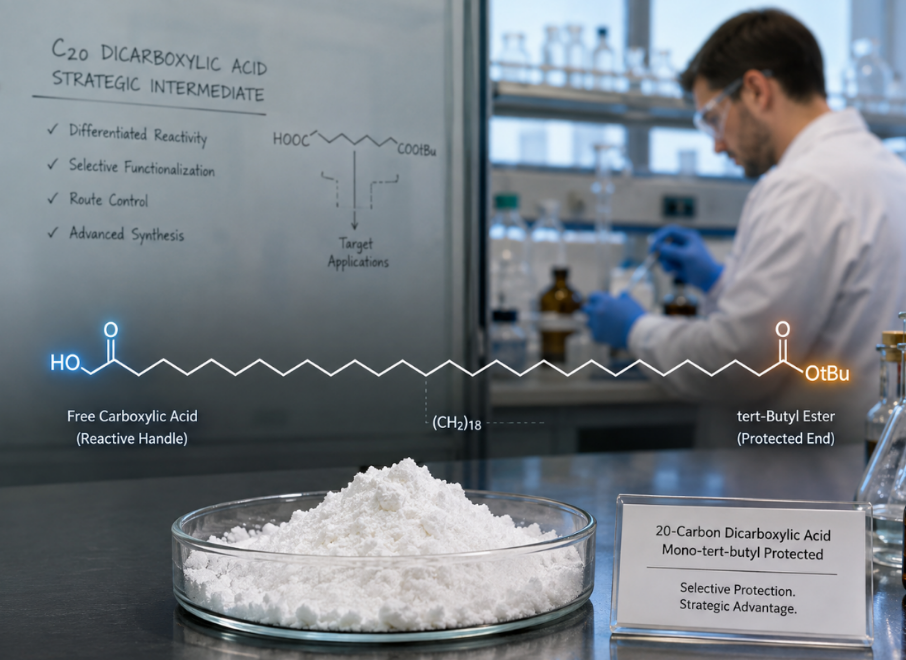
PubChem identifies CAS 683239-16-9 as 20-(tert-butoxy)-20-oxoicosanoic acid with formula C₂₄H₄₆O₄ and molecular weight 398.6 g/mol.
These identifiers provide a useful reference point because several C18 and C20 long-chain diacids and protected derivatives have similar names.
What Does “99% Purity” Tell You?
A search for 20-(tert-Butoxy)-20-oxoicosanoic acid 99% usually reflects a practical procurement question: is the material clean enough for the intended process?
The percentage is useful, but it should be read together with the analytical method.
Different methods measure different aspects of a material. This is why technical teams should confirm how purity is determined rather than comparing percentages in isolation.
The actual 683239-16-9 specification should therefore take priority over generic claims found in search results or supplier listings.
Why Protection State Matters
For CAS 683239-16-9, the chemical identity includes a mono-tert-butyl-protected terminus.
That feature is not a minor naming detail. It is what differentiates the compound from Eicosanedioic Acid, which contains two free carboxyl groups. PubChem lists Eicosanedioic Acid separately as CAS 2424-92-2, formula C₂₀H₃₈O₄ and molecular weight 342.5 g/mol.
For multistep chemistry, confirming the correct protection state can be just as important as confirming nominal purity.
To understand why this protection state matters, see Why Mono-tert-Butyl Protection Matters in C20 Dicarboxylic Acid Chemistry.
Batch Data Matters More as a Project Develops
During early screening, a standard specification may be sufficient.
Once the material enters repeat experiments, process optimization or scale-up evaluation, batch-to-batch consistency becomes more important.
Technical teams may want to compare:
-
identity results;
-
purity;
-
relevant impurity data;
-
appearance;
-
moisture or other agreed parameters;
-
consistency with previous batches.
Not every project requires the same tests. The appropriate specification should be defined around the downstream process.
COA vs. Specification: They Are Not the Same
A specification describes the acceptance criteria for the product.
A COA reports the results for a specific batch.
That distinction is important when evaluating an intermediate supplier. A well-written specification tells you what should be controlled; the COA tells you how a particular batch performed against those controls.
FAQ
Should I request a COA before evaluating CAS 683239-16-9?
For technical procurement, reviewing batch or representative quality data before larger-scale evaluation is useful.
Is 99% purity enough to qualify the material?
Not by itself. Purity should be reviewed together with identity, analytical method and the requirements of the downstream process.
For project-specific evaluation, the relevant specification and batch data should be confirmed before material selection.
View the CAS 683239-16-9 product information and specification for project evaluation.
For research use only.


