
![Fmoc-L-Lys[C20-OtBu-γ-Glu(OtBu)-AEEA-AEEA]-OH](/upload/2026/7/89-1.jpg "Fmoc-L-Lys[C20-OtBu-γ-Glu(OtBu)-AEEA-AEEA]-OH")
Epitalon vs Collagen Peptides: The 10x Price Gap Reflects Two Completely Different Anti-Aging Mechanisms
2026.08.07
One-sentence summary: Epitalon targets why cells age; collagen peptides address what to replenish after aging. The 10x price difference is not brand premium—it's a technological gap.
Introduction
One-sentence summary: Epitalon targets why cells age; collagen peptides address what to replenish after aging. The 10x price difference is not brand premium—it's a technological gap.
The anti-aging peptide market offers products ranging from a few dollars to thousands of dollars per gram. Many consumers lump all "peptides" into one category, assuming price differences are merely brand markup. Epitalon and collagen peptides, though both called "peptides," operate on entirely different levels—from molecular structure and mechanism of action to the biological targets they address.
The 10x price gap is not a "brand tax"—it's a technological divide. This article explains it once and for all.
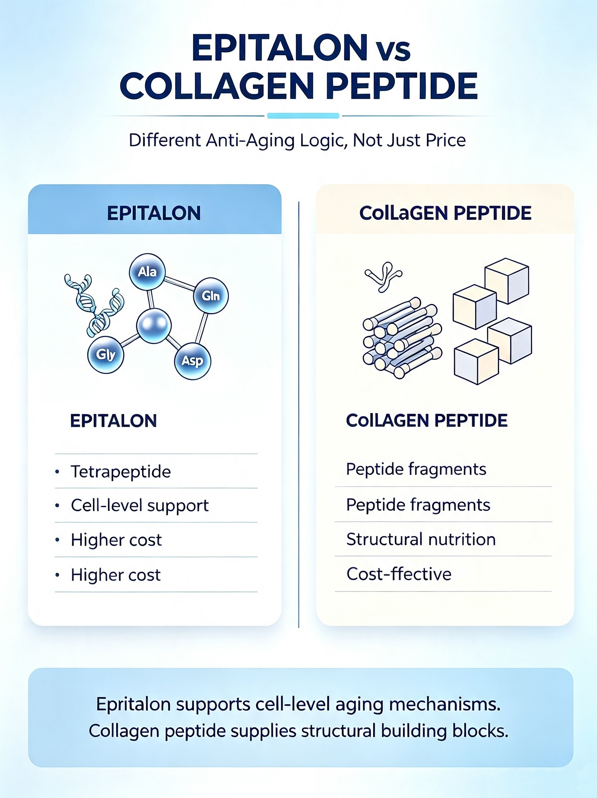
1. What Is Epitalon? — Genetic-Level Intervention in Aging
Epitalon (also spelled Epithalon) is a synthetic tetrapeptide with the amino acid sequence Ala-Glu-Asp-Gly (AEDG) , molecular formula C₁₄H₂₂N₄O₉, and molecular weight 390.35 Da. It was developed in the 1990s by Professor Vladimir Khavinson and colleagues at the St. Petersburg Institute of Bioregulation and Gerontology in Russia, designed as a short-peptide mimetic of the natural pineal gland extract epithalamin.
Core Mechanism: Telomerase Activation and Telomere Maintenance
Telomeres are the "protective caps" at the ends of chromosomes. Each time a cell divides, telomeres shorten. When they become critically short, cells enter senescence—irreversible growth arrest. Telomere length is recognized as a core hallmark of biological aging.
Epitalon works by upregulating hTERT mRNA expression and activating telomerase, enabling telomere elongation in normal human cells. A 2025 study published in Biogerontology confirmed that Epitalon extends telomere length in multiple normal human cell lines in a dose-dependent manner. Animal studies show it extends median and maximum lifespan in rodents by 12%–24%. In observational studies of elderly cohorts, Epitalon-treated groups showed reduced all-cause mortality over 6–12 years compared to controls.
The key distinction: Epitalon addresses why we age (telomere maintenance at the genetic level), not what to supplement after aging has occurred. This is the fundamental difference from collagen peptides.
2. What Are Collagen Peptides? — Structural Raw Material Replenishment
Collagen peptides are small-molecule fragments produced by hydrolyzing collagen, typically mixtures of 2–20 amino acids. After oral ingestion, they are absorbed in the intestine and enter the bloodstream partially as dipeptides and tripeptides.
Core Logic: Replenishing Depleted Structural Proteins
Collagen is the primary structural protein in skin, bone, and joints. As we age, collagen loss accelerates—so we supplement it externally.
Analogy: Collagen fibers in the skin are like a building; collagen peptides are the bricks delivered to the site. The building is deteriorating and losing bricks—you bring in new bricks. But whether the building gets repaired depends on whether the "construction crew" (fibroblasts) is still capable of working.
Numerous randomized, double-blind, placebo-controlled clinical trials have confirmed the efficacy of collagen peptides in improving skin hydration, elasticity, and wrinkles. A 2024 study published in the Journal of Dermatologic Science and Cosmetic Technology involving 70 participants demonstrated significant improvements in skin hydration, transepidermal water loss, elasticity, and dermal collagen content following oral collagen supplementation.
The problem: By age 40, fibroblast activity has declined by more than 50%. No matter how many bricks you supply, the crew can't do the job. The raw material isn't the issue—the workforce is.
3. Where Does the 10x Price Gap Come From?
3.1 Synthesis Process Gap
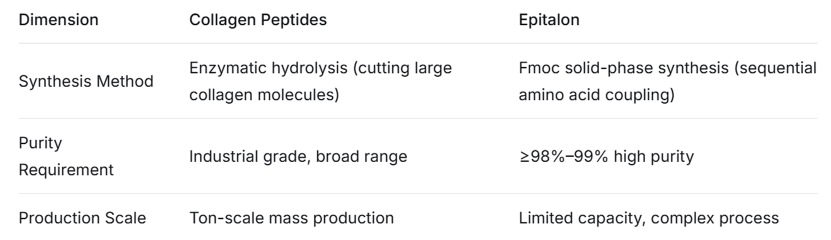
3.2 R&D Investment Gap
Epitalon is backed by over three decades of fundamental research by the Khavinson team—from telomere biology to animal models to human trials. Collagen peptide R&D focuses primarily on "hydrolysis process optimization" and "bioavailability validation"—a completely different order of investment.
3.3 Market Scale Gap
The global peptide skincare market was valued at approximately **$2.85 billion in 2025** and is projected to reach $6.35 billion by 2032. Collagen peptides represent a mature, multi-billion-dollar market where economies of scale have driven costs down significantly. The Epitalon market is substantially smaller, with no such scale effects.
3.4 Usage Barrier Gap
Collagen peptides are taken orally—anyone can use them. Epitalon typically requires injection or sublingual administration, involving professional guidance, with higher channel and service costs.
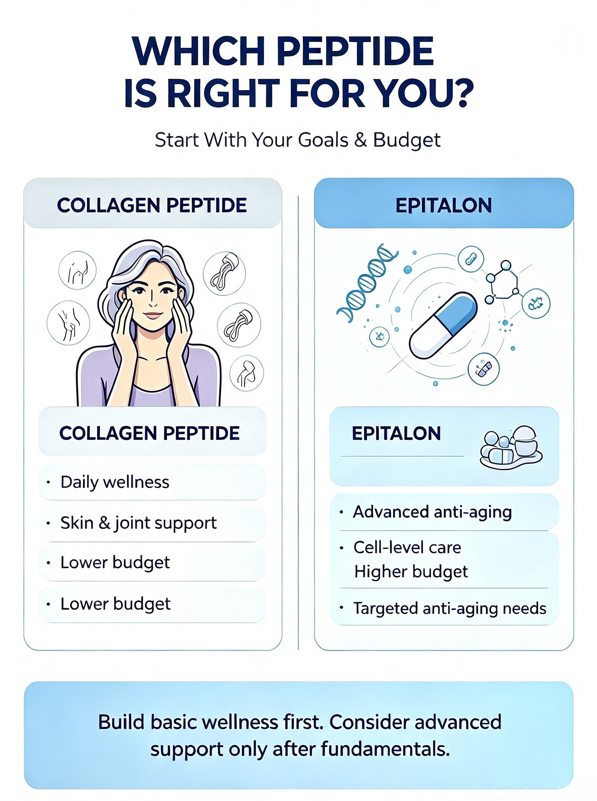
4. Which One Should You Choose? Don't Get It Backwards
Core advice: Match your choice to your needs and budget. Don't expect Epitalon-level results on a collagen peptide budget, and don't use Epitalon's budget to do collagen peptide's job.
✅ Choose Collagen Peptides If You:
-
Focus on daily maintenance—improving skin elasticity and joint comfort
-
Have a limited budget ($30–100/month)
-
Can commit to long-term oral supplementation
-
Prefer not to inject
This is the rational choice for 90% of people—the best cost-performance ratio.
✅ Consider Epitalon If You:
-
Are already doing systematic anti-aging management (not just casual supplementing)
-
Have a substantial budget ($600–1,500+/month)
-
Can accept injection or sublingual administration
-
Have professional channels to access reliable material and guidance
🔄 Want Both? They Can Be Combined
Epitalon is responsible for "keeping cells working longer"; collagen peptides provide "raw materials for cells to work with." Logically complementary.
But sequence matters: First establish the foundation (collagen peptides + vitamin C + sleep + exercise), then consider the advanced layer (Epitalon). Building the penthouse before the foundation is a waste of money.
5. Is the 10x Price Gap Worth It?
My answer: It's not about "worth it"—it's about "right for you."
-
Collagen peptides are mass-market wellness products—clear positioning, high cost-performance, suitable for the vast majority.
-
Epitalon is a frontier anti-aging tool—deeper mechanism, but higher barriers, higher cost, more complex usage—suitable for a minority with deep needs and adequate resources.
The biggest risk isn't overpaying—it's buying the wrong thing: approaching Epitalon with a collagen peptide mindset, or throwing Epitalon-level budget at collagen peptides.
Understanding what problem you're trying to solve matters more than fixating on price.


