
NAD⁺ Powder (β-Nicotinamide Adenine Dinucleotide) — Research-Grade Specifications, Stability & Bulk Supply
2026.11.25
Quick Answer
NAD⁺ (β-nicotinamide adenine dinucleotide, CAS 53-84-9) is supplied as a lyophilized, white to off-white crystalline powder at ≥98.0% assay by HPLC on a dry basis, packed as 1 kg minimum orders and 25 kg double-lined drums, with a 7–10 working-day lead time and a batch-specific COA.
Keep the sealed powder dry, dark and cold. In aqueous solution the molecule is most stable in the slightly acidic range (pH 5.5–6.0); hydrolysis accelerates sharply above pH 8, under prolonged light exposure, in the presence of trace metals, and after repeated freeze–thaw cycles.
This product is for research and development use only. It is not sterile, not for injection, and not for diagnostic or therapeutic use in humans or animals.
1. What NAD⁺ Is
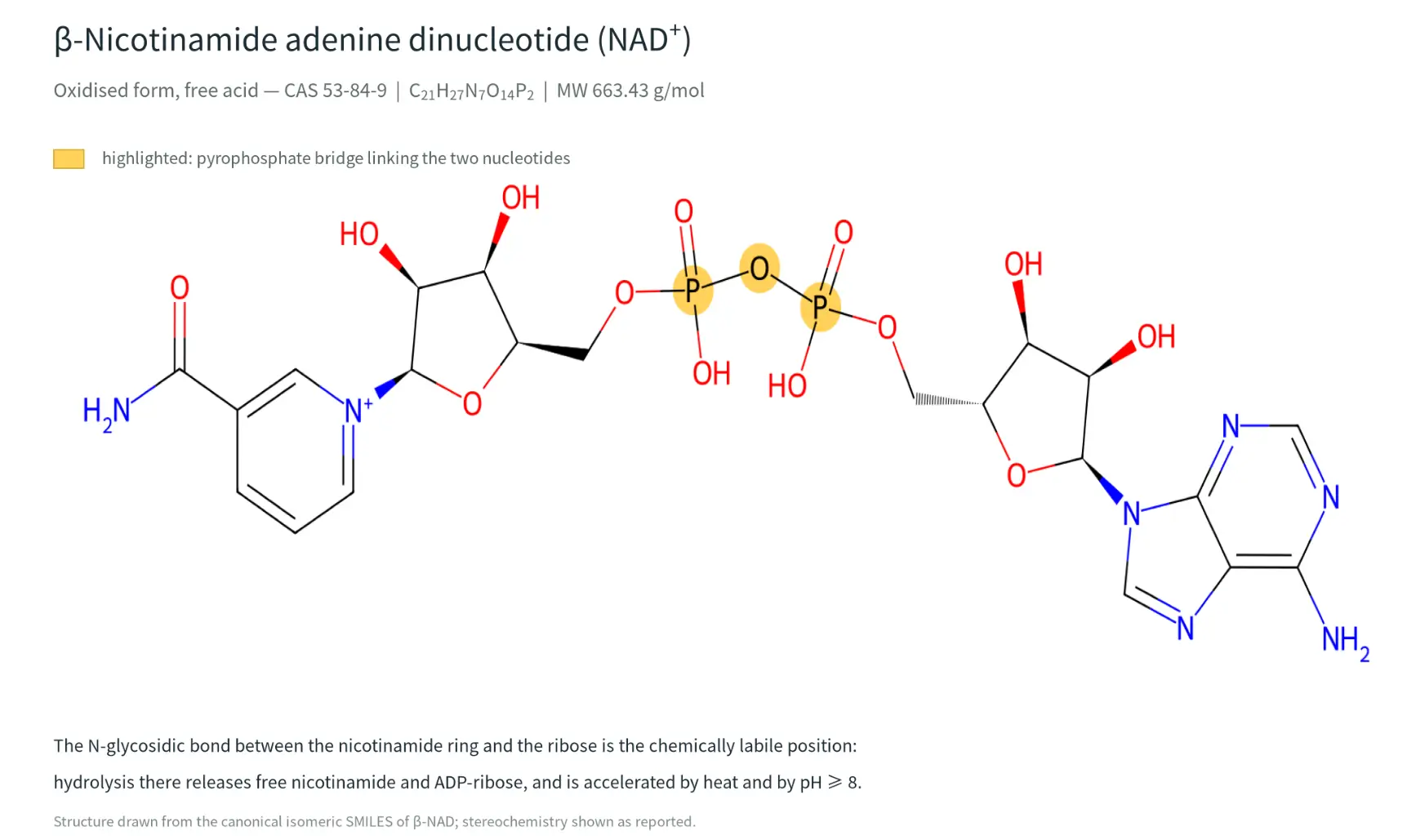
Nicotinamide adenine dinucleotide is a dinucleotide: an adenine nucleotide and a nicotinamide nucleotide joined through a pyrophosphate bridge. Its biological importance comes from the reversible hydride transfer between the oxidised form (NAD⁺) and the reduced form (NADH) — the reaction that lets NAD⁺ act as the electron acceptor for a large family of dehydrogenase enzymes.
Two practical consequences follow from that structure, and both matter to anyone buying the material:
- The redox pair is measurable. NADH absorbs at 340 nm while NAD⁺ does not. Any loss of NAD⁺ to degradation shows up as a weaker response in a 340 nm–based assay, which is why purity and identity testing for this material is built around UV and HPLC rather than appearance alone.
- The molecule has one chemically weak bond. The N-glycosidic bond between the nicotinamide ring and the ribose is the first thing to break under heat, moisture or alkaline conditions, releasing free nicotinamide. That single reaction accounts for most of the degradation discussed in Section 4.
Product parameters
|
Parameter |
Value |
|
Product name |
β-Nicotinamide adenine dinucleotide (NAD⁺), free acid |
|
CAS number |
53-84-9 |
|
Molecular formula |
C₂₁H₂₇N₇O₁₄P₂ |
|
Molecular weight |
663.43 g/mol (anhydrous basis) |
|
Appearance |
White to off-white crystalline powder |
|
Assay |
≥98.0% (HPLC, dry basis) |
|
Form |
Lyophilized powder |
|
Storage |
Sealed, dry, protected from light; −20 °C for long-term storage |
|
Packaging |
25 kg double-lined drum; 1 kg minimum order |
|
Lead time |
7–10 working days |
Values above reflect the standard commercial specification. Batch-specific results are stated on the certificate of analysis accompanying each lot.
2. Where NAD⁺ Is Used in the Laboratory
NAD⁺ is a working reagent, not a finished product. The demand for bulk quantities comes from four recurring laboratory contexts.
Oxidoreductase and dehydrogenase assays. Lactate dehydrogenase, alcohol dehydrogenase, glucose-6-phosphate dehydrogenase and similar enzymes all require NAD⁺ as the electron acceptor. The rate of NADH formation at 340 nm is the readout, so any residual degradation in the starting material translates directly into a shifted standard curve.
NAD⁺-dependent enzymology. Sirtuins, PARPs and CD38-family enzymes consume NAD⁺ as a substrate rather than as a cofactor. Work on these pathways is sensitive to both the concentration and the integrity of the dinucleotide, because free nicotinamide generated by hydrolysis is itself a product inhibitor of several of these enzymes — sirtuins are inhibited non-competitively in the tens-of-micromolar range, PARP-1 around 31 µM (see ref. 6). This is the single most under-appreciated reason to care about storage conditions.
Cell and metabolic research. Supplementation studies in culture systems, mitochondrial and redox research, and work on cellular NAD⁺ metabolism all draw on research-grade material as a defined input rather than an extract.
Analytical work. NAD⁺ is used as a reference standard and as an analyte in method development and validation — identity by UV λmax and HPLC retention, quantification against a certified reference where available.
For the underlying biology and the role of NAD⁺ as a redox carrier and signalling molecule in research models, see Rajman, Chwalek and Sinclair (2018), listed in the References. All statements on this page concern laboratory use; nothing here describes or supports human or veterinary administration.
Related research reagents from the same catalogue: reduced glutathione (CAS 70-18-8) and L-carnitine (CAS 541-15-0), both supplied under the same documentation regime.
3. Specifications: What a NAD⁺ Spec Sheet Should Contain
A supplier's spec sheet is only useful if it tells you what is measured and how. For NAD⁺ powder, the following items are the ones that actually determine whether the material will behave in an assay.
The table is written as a checklist for evaluating any NAD⁺ supplier, this one included: for each line, ask for the test method and the acceptance criterion, not only a result. A specification you can interrogate is more useful than a longer one you cannot. The current NAD⁺ specification sheet and bulk pricing can be requested before ordering.
|
Test |
Method |
Why it matters |
|
Assay / purity |
HPLC, dry basis |
The headline number; below specification means shorter effective life in solution |
|
Identity |
UV λmax, HPLC retention time |
Confirms the dinucleotide, not a related nucleotide or a salt form |
|
Appearance |
Visual |
Off-white is normal; deep yellow or brown signals degradation |
|
Water content |
Karl Fischer |
Residual moisture drives hydrolysis in the solid state |
|
pH of solution |
Potentiometric |
Free acid solutions are acidic; relevant when preparing buffers |
|
Solubility |
Gravimetric, in water |
Determines the workable stock concentration for your assay |
|
Heavy metals |
ICP-MS / pharmacopoeial method |
Trace metals catalyse oxidative side reactions |
|
Residual solvents |
GC |
Process control |
|
Microbial limits |
Pharmacopoeial method |
Non-sterile material still needs a bioburden ceiling |
|
Endotoxin |
LAL, on request |
Needed only for specific cell-based applications |
Two notes on how to read this table. First, ask for the acceptance criteria, not just the result — a COA that reports a number without a specification limit tells you nothing about consistency between lots. Second, ask whether assay is reported on an "as is" or dry basis; the two figures differ by the water content and can look like a purity discrepancy when they are not.
4. Stability: What Actually Degrades NAD⁺
This is the section most suppliers skip, and the one that determines whether your results reproduce in six months.
4.1 The hydrolysis pathway
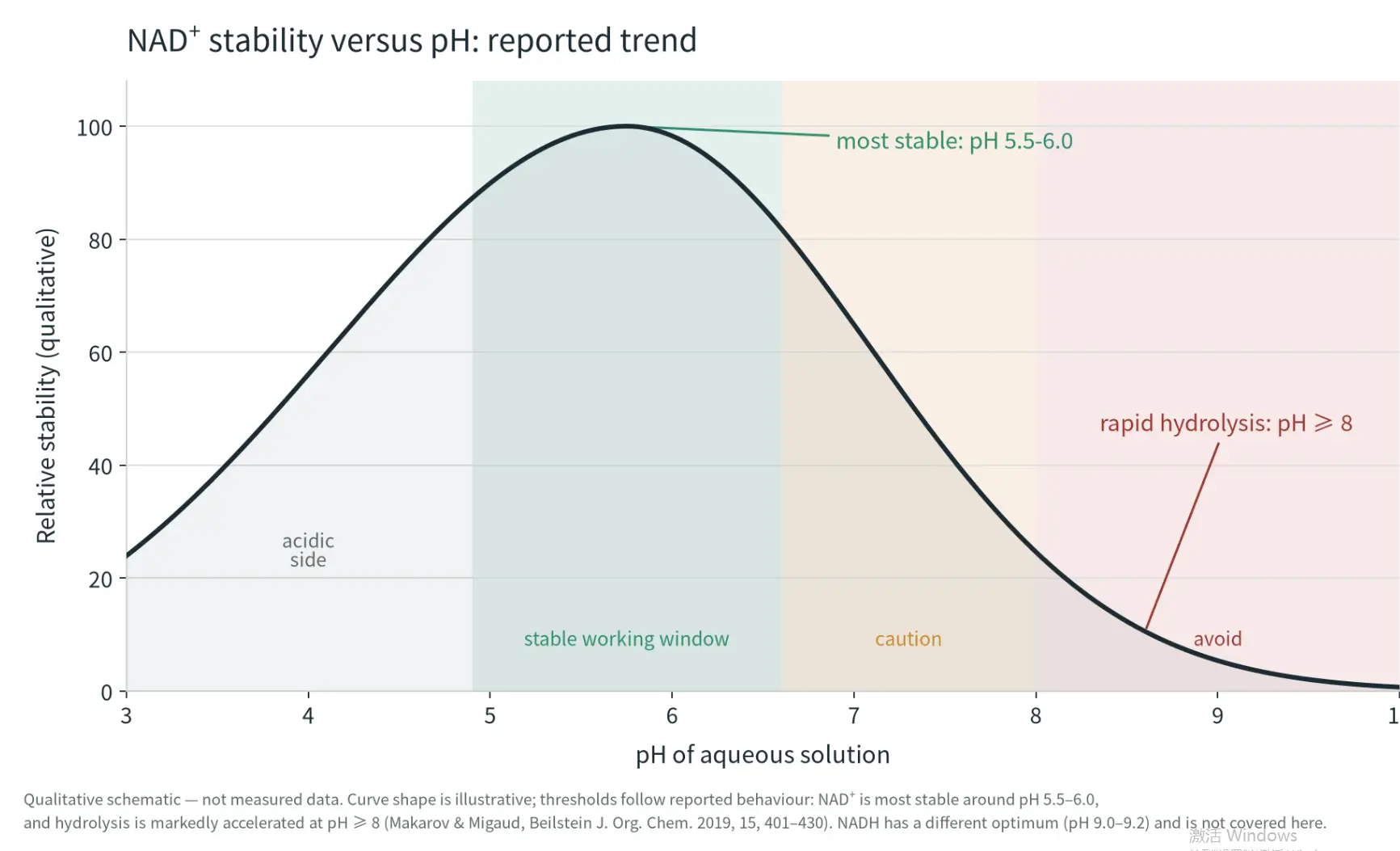
NAD⁺ decomposes primarily by hydrolysis of the glycosidic bond, splitting into nicotinamide and ADP-ribose. The reaction is base-catalysed, so it is strongly pH-dependent. Published work on nicotinamide riboside and its analogues reports that NAD⁺ is most stable in the slightly acidic range of about pH 5.5–6.0, with decomposition markedly accelerated by heat and by basic conditions at pH 8 and above (Makarov & Migaud, Beilstein J. Org. Chem. 2019).
A detail that is frequently gotten wrong: the pH optimum for NAD⁺ is not the same as for NADH. The reduced form is more stable in mildly alkaline media, around pH 9.0–9.2. Suppliers and protocols that quote one pH window for both forms are conflating two different molecules, and the error becomes visible the moment someone tries to store a NADH stock using NAD⁺ conditions.
4.2 Buffer effects
Buffer choice is not neutral. A factorial-design study of NAD(H) stability by UV-visible spectrophotometry found that degradation was faster in phosphate buffer, attributed to adduct formation with the pyridine ring, and that pH and temperature were the dominant factors, with pH having the largest effect (PMID 9648652).
Practical translation: if your assay historically uses phosphate, keep it — but prepare working solutions fresh rather than holding them, and do not assume a phosphate stock will survive a week at 4 °C simply because it is cold.
4.3 Temperature
Hydrolysis kinetics follow the usual rule of thumb that reaction rate roughly doubles for every 10 °C increase. This is why a solution that is acceptable overnight at 4 °C is not acceptable overnight at 25 °C, and why ambient shipping is tolerable for sealed powder but never for a reconstituted solution.
4.4 Light
The nicotinamide ring absorbs in the UV range, and photodegradation is a real pathway rather than a theoretical one. Amber glass, foil wrapping or opaque secondary packaging are standard mitigations, and bench work with this material should avoid prolonged direct light exposure.
4.5 Trace metals and oxygen
Fe²⁺ and Cu²⁺ catalyse oxidative side reactions. Use high-purity water, avoid prolonged contact with stainless steel surfaces during preparation, and prefer plasticware or glass for stock solutions.
4.6 Moisture in the solid state
In the dry state, hydrolysis is limited by the absence of water, which is exactly why the lyophilized form is the stable commercial form. Residual moisture — as measured by Karl Fischer — is therefore a stability parameter, not just a release-test formality. Desiccant in the container and a tight seal are doing real work.
4.7 A note on how to judge a supplier's stability claim
Long-term and accelerated stability programmes for a research reagent are normally designed around the ICH Q1A(R2) framework: long-term storage at the intended condition, plus accelerated conditions at elevated temperature and humidity, sampled at defined intervals. When a supplier quotes a shelf life without saying which conditions and which intervals back it up, the number is marketing rather than data. Ask for the storage condition, the test intervals, and the analytical method used at each point.
5. Storage and Handling
5.1 Powder, sealed
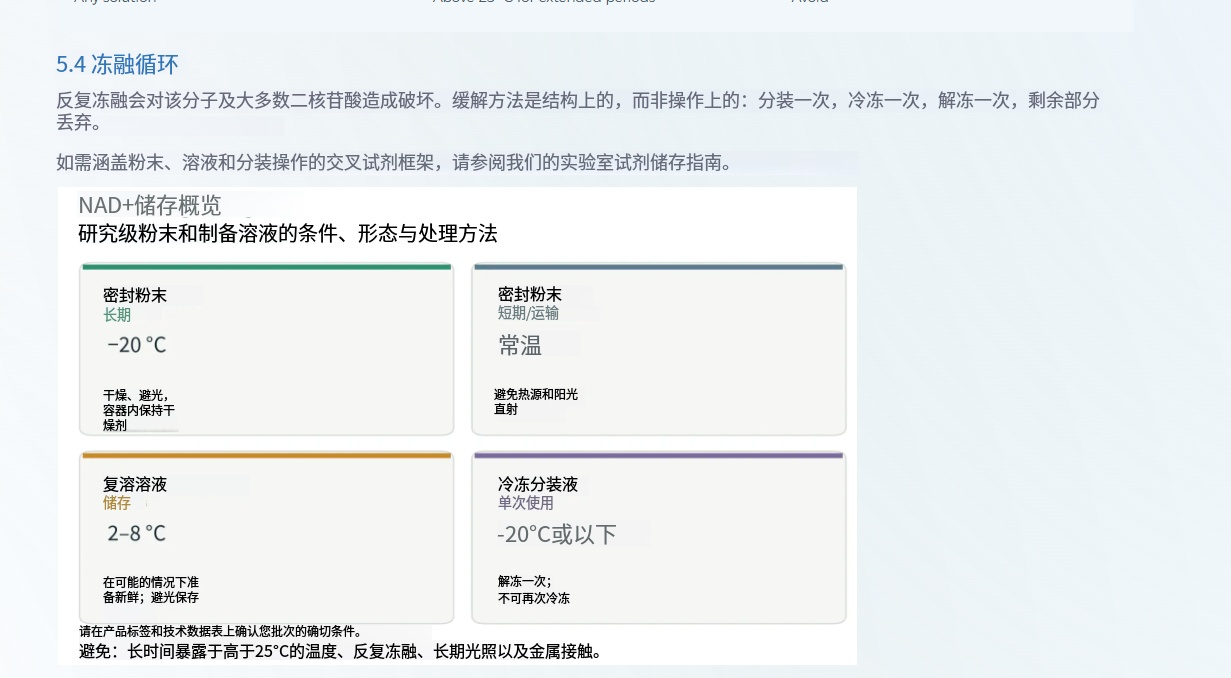
- For long-term holding, keep the material frozen (−20 °C is common practice for this grade) in the original sealed container, protected from light. Confirm the exact condition on the product label and the technical data sheet for your lot.
- Keep the desiccant in the container; reseal immediately after weighing.
- Allow the container to equilibrate to room temperature before opening, to avoid condensation on the cold powder.
- Minimise the number of times a bulk container is opened; split into working aliquots if the container will be used repeatedly.
5.2 Solution
- Prepare at the concentration your assay requires and use promptly; do not hold dilute working solutions across days.
- If a stock must be kept, aliquot and freeze rather than storing a large volume at 4 °C.
- Protect from light and avoid metal contact.
5.3 In transit and at the bench
|
State |
Condition |
Handling |
|
Sealed powder |
Ambient, short term |
Acceptable; avoid heat sources and direct sun |
|
Sealed powder |
Long term |
−20 °C, desiccated, dark |
|
Reconstituted solution |
2–8 °C |
Short holding only; prepare fresh where practical |
|
Frozen aliquot |
−20 °C or below |
Single use; limit freeze–thaw cycles |
|
Any solution |
Above 25 °C for extended periods |
Avoid |
5.4 Freeze–thaw
Repeated freeze–thaw is destructive to this molecule and to most dinucleotides. The mitigation is structural rather than procedural: aliquot once, freeze once, thaw once, discard the remainder.
For a cross-reagent framework covering powder, solution and aliquot handling, see our laboratory reagent storage guide.
6. Laboratory Reconstitution
For research use, the goal of reconstitution is a defined, buffer-compatible stock — not a sterile pharmaceutical preparation.
- Weigh the powder into a clean vessel, working quickly to limit moisture uptake.
- Choose the diluent. High-purity water for initial dissolution, then buffer to the pH your assay requires. If the stock is intended for storage rather than immediate use, target the slightly acidic range rather than neutral-to-alkaline.
- Dissolve gently. Swirl or rock; avoid vigorous vortexing, which generates shear and foam without speeding dissolution appreciably.
- Check pH if the stock will be held. Free acid solutions are themselves acidic, and adding powder to an unbuffered diluent will shift the pH downward.
- Clarify or sterilise if needed. A 0.22 µm filter is appropriate where bioburden matters, but verify recovery — some membrane materials adsorb dinucleotides, and a filtered stock should be re-checked against an unfiltered reference.
- Aliquot and freeze immediately if the stock is not for same-day use.
- Label with concentration, diluent, pH and date.
Do not apply pharmaceutical compounding practice to this material. Where a preservative-containing diluent is being considered, verify compatibility against your readout first: benzyl alcohol absorbs strongly in the same near-UV region used to quantify NAD⁺ (around 260 nm), so a bacteriostatic diluent can distort UV-based readings even when the dinucleotide itself is intact. A preservative-free diluent keeps the measurement clean and removes the variable.
7. Quality Control and Documentation
For a research reagent, documentation is part of the product. Rather than asserting a fixed document set, the more useful approach is to state what should be requested and verified before a first order — because the answer differs by supplier and by destination.
- Certificate of analysis (COA) — ask which items are covered, what method stands behind each, and what the acceptance limit is. A COA that reports results without specification limits cannot support lot-to-lot comparison. For a worked checklist, see how to verify a certificate of analysis.
- Analytical data — an HPLC chromatogram for the lot you will actually receive, not a representative example from a different batch.
- Batch traceability — batch number, manufacture date and retest date printed on the label and cross-referenced to the COA.
- Safety and technical data — MSDS and TDS issued before purchase, so that handling and storage decisions are made against the real document rather than a summary on a website.
- Quality system evidence — the scope of certification, not only the certificate. JunTai Pharm operates an ISO 9001:2015–certified quality management system at a manufacturing site that entered operation in 2022, within a group that has supplied raw materials for more than a decade.
The documentation package for a specific lot can be requested from the sales contact on this site before ordering.
8. Packaging, MOQ and Lead Time
|
Item |
Detail |
|
Minimum order |
1 kg |
|
Bulk packaging |
25 kg double-lined drum with desiccant |
|
Inner protection |
Light-barrier liner as standard; amber containment confirmed at quotation |
|
Samples |
Evaluation samples can be requested at quotation |
|
Lead time |
7–10 working days |
|
Customisation |
Packaging size, labelling and documentation aligned to your requirement — confirmed at quotation |
|
Shipping |
Classification, HS code and shipping documents confirmed at quotation |
Lead time is where sourcing decisions are often actually made. A 7–10 working-day turnaround from a Chinese manufacturer matters more to a formulator with a running project than a marginally lower price quoted against a four-week delivery.
9. Signs of Degradation, and What to Do
|
Observation |
Likely meaning |
Action |
|
Slight off-white to faint yellow tint |
Within normal range for the material |
Accept; record on receipt |
|
Deep yellow, amber or brown colour |
Advanced degradation or contamination |
Quarantine; confirm by HPLC before use |
|
Cloudiness or visible particles in solution |
Insoluble matter, aggregation or microbial contamination |
Discard |
|
Undissolved residue after gentle mixing |
Poor dissolution or foreign matter |
Do not force it; investigate |
|
HPLC purity below specification, rising free nicotinamide peak |
Hydrolysis has progressed |
Discard or re-qualify |
|
Weaker-than-expected A340 response in a validated enzyme assay |
Functional loss of the cofactor |
Re-run with a fresh, sealed lot |
|
pH drift in a stored stock |
Hydrolysis and buffer failure |
Discard stock |
A single rule covers most of this: if the material looks different from the reference appearance, or if the assay disagrees with the COA, stop and re-test rather than adjusting the protocol to fit the reagent.
10. Frequently Asked Questions
What purity is your NAD⁺ powder?
≥98.0% by HPLC on a dry basis. The exact result, the chromatogram and the acceptance criteria for your specific lot are stated on the certificate of analysis.
Is NAD⁺ stable at room temperature?
The sealed powder tolerates ambient conditions for short periods, which is why standard shipping is workable. A reconstituted solution does not — hydrolysis proceeds quickly at 25 °C and the material should be refrigerated or aliquoted and frozen.
Why has my NAD⁺ powder turned yellow?
A faint yellowish tint is within the normal appearance range. Deep yellow, amber or brown indicates that hydrolysis and oxidation have progressed, usually through moisture uptake or repeated exposure to warm conditions. Confirm with HPLC rather than judging by colour alone.
At what pH is NAD⁺ most stable?
Around pH 5.5–6.0. Decomposition accelerates markedly at pH 8 and above. Note that NADH has a different optimum (mildly alkaline), so a single pH rule should not be applied to both forms.
Should I prepare NAD⁺ in phosphate buffer?
Phosphate has been reported to accelerate NAD(H) degradation through adduct formation. If your validated method requires phosphate, prepare working solutions fresh instead of storing them.
Can I freeze a NAD⁺ solution?
Yes, as single-use aliquots at −20 °C or below. Repeated freeze–thaw cycles damage the molecule, so aliquot once and discard what you do not use.
What is the difference between NAD⁺, NADH, NMN and NR?
NAD⁺ and NADH are the oxidised and reduced forms of the same dinucleotide and interconvert in redox reactions. NMN and NR are mononucleotides that serve as precursors in biosynthetic pathways; they are different molecules with different molecular weights and different stability profiles, and they are not interchangeable with NAD⁺ on a molar basis. For a side-by-side comparison of the four, see NAD⁺ vs NMN vs NR: chemical differences and sourcing choices.
Do you provide a COA with every batch?
A lot-specific COA is available before purchase and is cross-referenced to the batch number on the label. Request it against the batch you intend to order, so the document matches the material you will actually receive and your own QA template.
What is your MOQ and lead time?
1 kg minimum order, 25 kg drums for scale-up, 7–10 working days from confirmed order. Evaluation samples are available.
Is NAD⁺ soluble in water?
Yes, it dissolves readily in aqueous systems at the concentrations normally used in assays. Exact solubility data for the current grade is available in the TDS on request.
Is this product sterile or suitable for injection?
No. This is a research-grade reagent supplied non-sterile, for laboratory and development use only. It is not for human or veterinary administration, not for diagnostic use, and not for pharmaceutical compounding.
Can you provide custom packaging or documentation?
Yes — packaging size, labelling and documentation packages can be aligned to your destination and internal QA requirements. Send the specification and we will confirm feasibility.
References
- Makarov, M. V.; Migaud, M. E. Syntheses and chemical properties of β-nicotinamide riboside and its analogues and derivatives. Beilstein J. Org. Chem. 2019, 15, 401–430. doi:10.3762/bjoc.15.36
- Rajman, L.; Chwalek, K.; Sinclair, D. A. Therapeutic Potential of NAD-Boosting Molecules: The In Vivo Evidence. Cell Metab. 2018, 27 (3), 529–547. doi:10.1016/j.cmet.2018.02.011 (PMID 29514064)
- Study of NADH stability using ultraviolet-visible spectrophotometric analysis and factorial design. PubMed PMID 9648652.
- ICH Harmonised Tripartite Guideline Q1A(R2): Stability Testing of New Drug Substances and Products.
- USP General Chapter ⟨1043⟩ Ancillary Materials for Cell, Gene, and Tissue-Engineered Products.
- Possible Adverse Effects of High-Dose Nicotinamide: Mechanisms and Safety Assessment. PMC7277745 — review reporting the inhibitory constants for nicotinamide against PARP-1 (≈31 µM) and SIRT1 (50–180 µM).
Reference-grade physical data quoted in Section 1 (CAS 53-84-9, C₂₁H₂₇N₇O₁₄P₂, 663.43 g/mol, pH 2.5–3.0 at 10 g/L) are consistent with published supplier specifications for the free acid form.
Author & Review
Written by: Technical & Documentation Team, JunTai Pharm
Reviewed by: Quality Department, JunTai Pharm
Manufacturer: JunTai Pharm — juntaipharm.com | Published on h2opharm.com
Last updated: 2026-11-25
Disclaimer. This document is provided for research and development use only. NAD⁺ described here is a laboratory reagent, not a drug, cosmetic ingredient for finished formulation, food ingredient, or medical device. Nothing on this page constitutes a recommendation for human or animal administration, a dosing instruction, or a formulation specification. Users are responsible for verifying regulatory status in their own jurisdiction before any application.


