
How to Verify a BPC 157 Certificate of Analysis (COA): A B2B Sourcing & QC Checklist for R&D Teams
2026.11.23
- Disclaimer: This quality control guide is intended solely for academic research institutes, pharmaceutical R&D teams, and B2B procurement professionals. BPC 157 (CAS 137525-51-0) is supplied strictly for Research Use Only (RUO) and is not intended for human, diagnostic, or clinical use.
Why a Single "≥98% Purity" Claim Is Not Enough for R&D Procurement
- For principal investigators, analytical chemists, and pharmaceutical procurement managers, sourcing synthetic BPC 157 (CAS 137525-51-0) requires rigorous vendor qualification. A frequent pitfall in peptide procurement is relying solely on a summary Certificate of Analysis (COA) that lists "≥98% purity" without supporting raw chromatographic or mass spectrometric data.
- In sensitive in vitro assays or analytical method development, uncharacterized deletion sequences, truncated fragments, or residual counterions can compromise experimental reproducibility. A compliant, batch-specific COA must provide orthogonal analytical characterization—confirming molecular identity, chromatographic purity, and actual net peptide content.
5 Essential Analytical Parameters to Audit on a BPC 157 COA
1.Molecular Identity Confirmation via ESI-MS or LC-MS
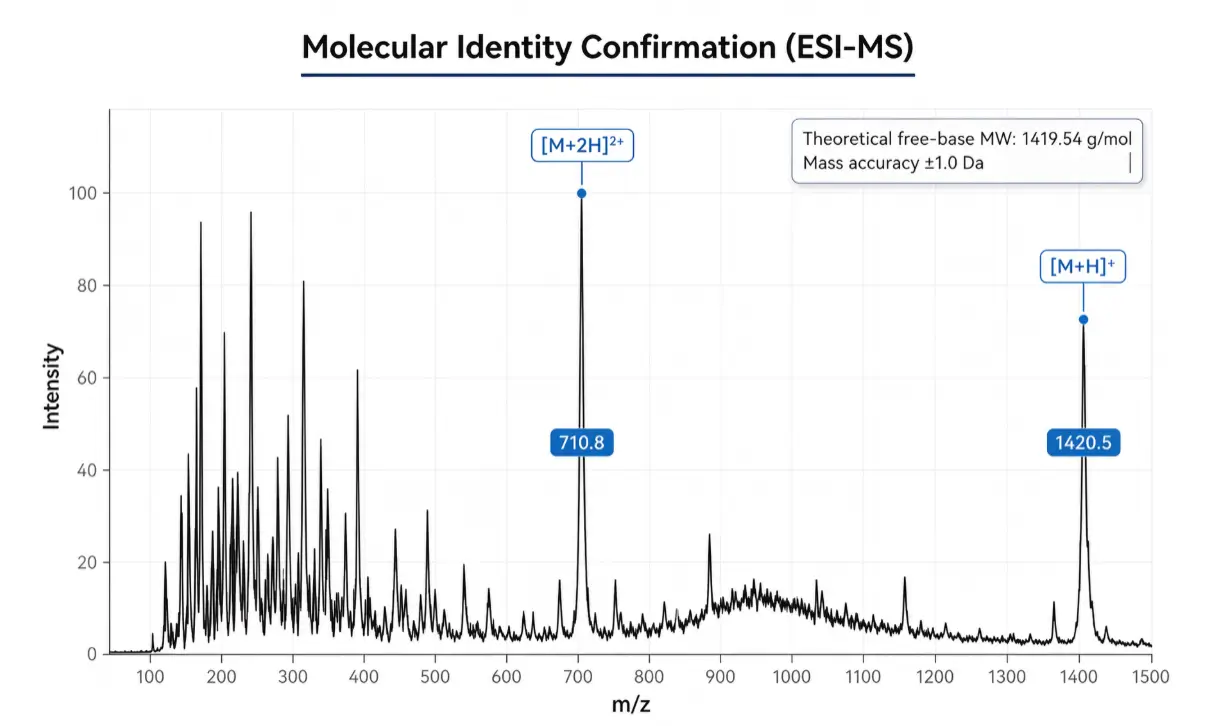
- Reversed-phase HPLC retention time alone does not prove sequence accuracy. A legitimate COA must be accompanied by an Electrospray Ionization Mass Spectrometry (ESI-MS) spectrum verifying the theoretical free-base molecular weight of BPC 157 (1419.54 g/mol, formula C₆₂H₉₈N₁₆O₂₂, sequence
GEPPPGKPADDAGLV). QC reviewers should check for clear protonated molecular ion peaks around m/z 1420.5 ([M+H]⁺) and m/z 710.8 ([M+2H]²⁺) within acceptable mass accuracy tolerances (typically ±1.0 Da).
2.Chromatographic Purity & Raw RP-HPLC Chromatogram Review
- Research-grade BPC 157 typically requires ≥98.0% purity by RP-HPLC (measured at 214 nm or 220 nm UV detection). Always request the full chromatogram rather than just a typed percentage. Inspect the peak integration table, baseline stability, and gradient conditions to confirm that adjacent failure sequences or oxidized impurities are properly resolved and integrated.
3.Net Peptide Content (Elemental Analysis) & Salt Form
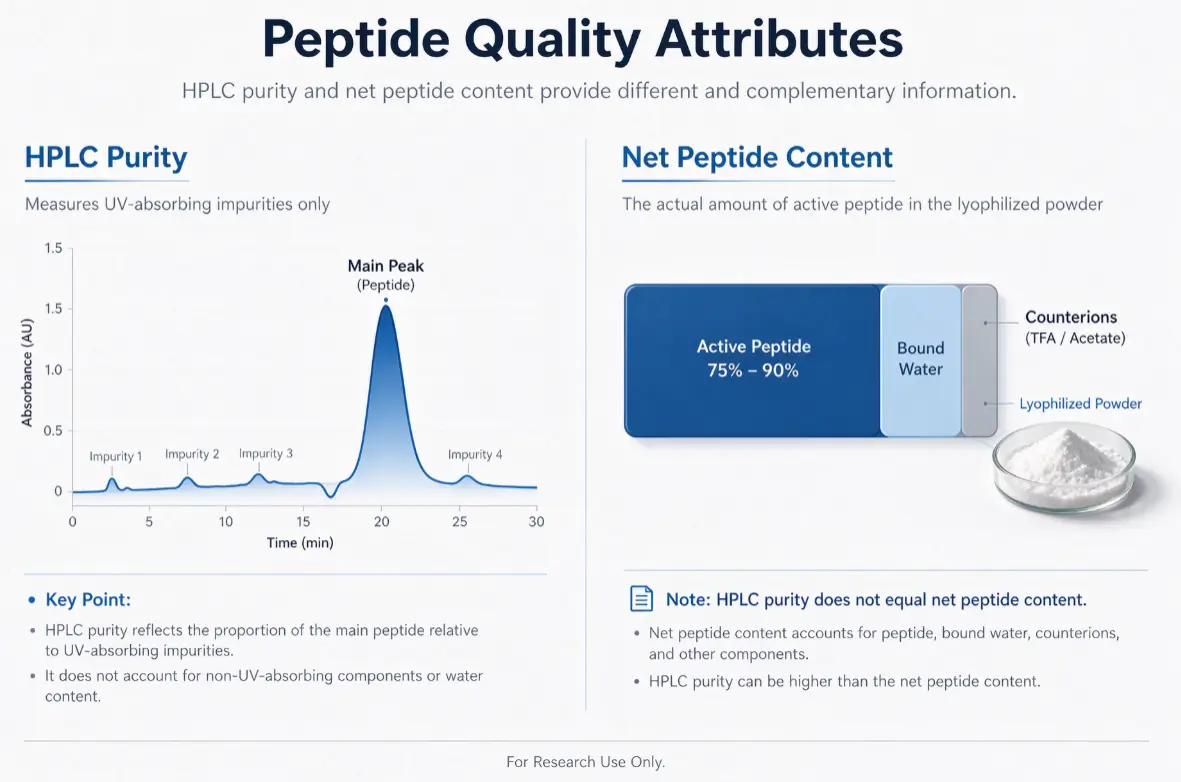
- HPLC measures UV-absorbing purity, not the weight percentage of active peptide in the lyophilized powder. Because lyophilized BPC 157 contains bound water and counterions (such as trifluoroacetate or acetate), actual Net Peptide Content typically ranges between 75% and 90%. For precise molarity calculations in R&D assays, verify whether the supplier provides Amino Acid Analysis (AAA) or Elemental Nitrogen Analysis, and confirm the exact salt form (for details, see our guide on BPC 157 TFA vs. Acetate vs. Arginate Salt Forms (注:发布时替换为第一篇博客链接)).
4. Residual Moisture (Karl Fischer Titration) & Solubility
- Excess residual moisture accelerates hydrolytic degradation and affects weighing accuracy. High-standard COAs report water content via Karl Fischer (KF) titration (typically ≤6.0%) alongside physical appearance (white to off-white lyophilized powder) and clear aqueous solubility verification.
5. Application-Specific Testing: Endotoxins & Residual TFA
- Depending on downstream R&D protocols, laboratories may require supplemental testing beyond routine release specifications:
- Bacterial Endotoxins (LAL Test): Critical for sensitive cellular or immunological in vitro models (commonly controlled at <5 EU/mg or <1 EU/mg).
- Residual TFA Analysis: Measured via Ion Chromatography (IC) or ¹⁹F-NMR when sourcing BPC 157 acetate salt to ensure trifluoroacetate levels meet assay tolerances.
Supplier COA Audit Checklist: Red Flags vs. Verified Standards
| Audit Item | Verified R&D Standard | Supplier Red Flags |
|---|---|---|
| Batch Traceability | Unique lot/batch number printed on vial label matches the COA header and test date. |
Generic "sample COA" with no lot number, missing dates, or reused historical data. |
| Raw Data Attachments | Full RP-HPLC chromatogram (with retention time & area %) and MS spectrum attached. |
Only a single typed "99% Purity" number with no chromatographic peak breakdown. |
| Method Transparency | Specifies HPLC column type, mobile phase gradient, wavelength (e.g., 214 nm), and MS mode. |
No analytical method parameters disclosed; refuses third-party re-testing inquiries. |
| Chemical & Salt Specs | Explicitly states CAS 137525-51-0, sequence, theoretical vs. observed MW, and salt form. |
Vague chemical description; fails to distinguish between TFA salt and acetate salt. |
Batch-Traceable BPC 157 Supply for Research Institutes and Pharma R&D
- Reliable scientific outcomes depend on well-characterized reference materials. At Guocheng Pharma, every batch of BPC 157 Research Peptide (CAS 137525-51-0) undergoes multi-step analytical verification before release, ensuring ≥98% HPLC purity and strict lot-to-lot consistency.
- To support university laboratories, biotech companies, and pharmaceutical procurement teams, we provide:Contact our technical team today to request a sample batch COA or discuss your project specifications.
- Complete Analytical Documentation: Batch-specific COA, original RP-HPLC chromatograms, and ESI-MS spectra delivered with every order (and available for pre-shipment review).
- Supplemental QC Testing: Optional Amino Acid Analysis (AAA), Karl Fischer moisture testing, endotoxin screening, and residual TFA verification upon request.
- Custom Synthesis & Packaging: Tailored salt forms, isotope-labeled standards, and milligram-to-gram packaging under strict NDA protection via our Custom Peptide Synthesis Support.


