BPC 157 Salt Forms Explained: TFA vs. Acetate vs. Arginate for R&D and Bulk Sourcing
2026.11.23
Disclaimer: This technical guide is provided strictly for laboratory research, analytical method development, and B2B chemical sourcing reference. BPC 157 (CAS 137525-51-0) is supplied exclusively for Research Use Only (RUO) and is not intended for human, diagnostic, or veterinary applications.
Why Salt Form Matters When Sourcing BPC 157 (CAS 137525-51-0)
- When sourcing synthetic BPC 157 (CAS 137525-51-0) for pharmaceutical R&D or commercial distribution, confirming the 15-amino-acid sequence (
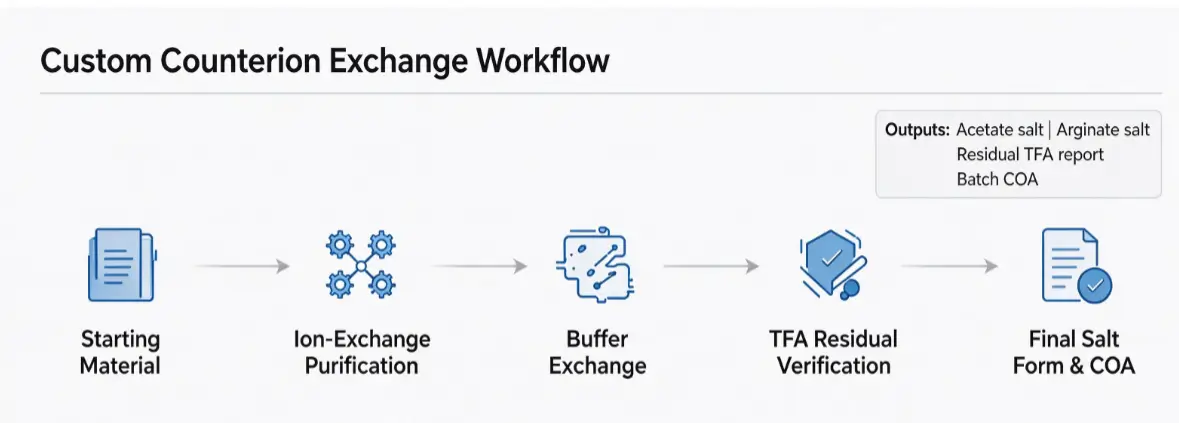
GEPPPGKPADDAGLV) and chromatographic purity (≥98% by HPLC) is only the baseline requirement. Under modern analytical and regulatory scrutiny, different salt forms of the same peptide are treated as distinct chemical entities in quality documentation. - Because standard solid-phase peptide synthesis (SPPS) and reversed-phase HPLC purification rely on trifluoroacetic acid (TFA), raw lyophilized BPC 157 naturally isolates as a TFA salt. Understanding when to use standard TFA salt versus requesting counterion exchange into acetate or arginate forms is critical for experimental accuracy and supply chain transparency.
Molecular Structure of BPC 157 and Counterion Binding
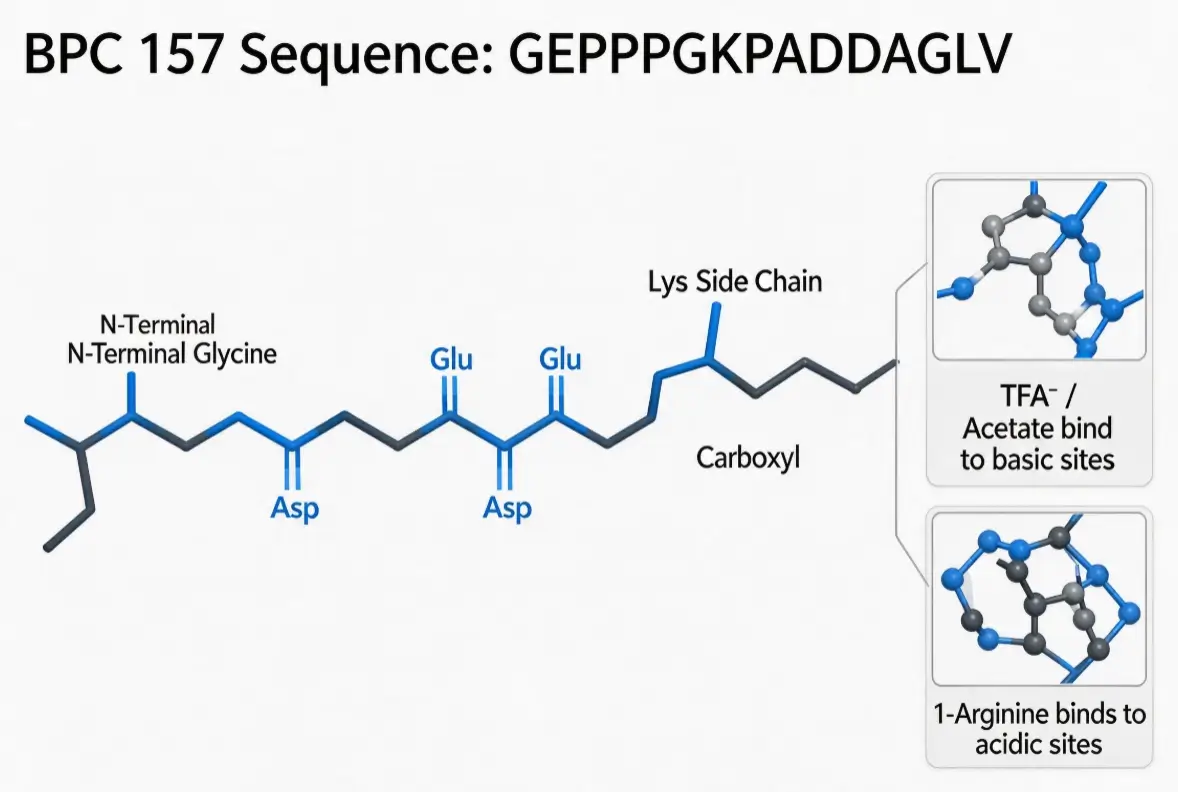
- BPC 157 has a molecular formula of C₆₂H₉₈N₁₆O₂₂ and a free-base theoretical molecular weight of 1419.54 g/mol. Structurally, it is an amphoteric linear pentadecapeptide containing both basic and acidic residues:
- Basic sites (positively charged at low pH): The N-terminal Glycine amine and the ε-amino group of Lysine (Lys). These sites bind negatively charged counterions such as trifluoroacetate (TFA⁻) or acetate (CH₃COO⁻).
- Acidic sites (negatively charged at neutral/high pH): One Glutamic acid (Glu) and two Aspartic acid (Asp) residues, plus the C-terminal carboxyl group. These acidic sites allow BPC 157 to form stable complexes with basic counterions like L-arginine.
BPC 157 TFA Salt vs. Acetate Salt vs. Arginate Salt: Technical Comparison
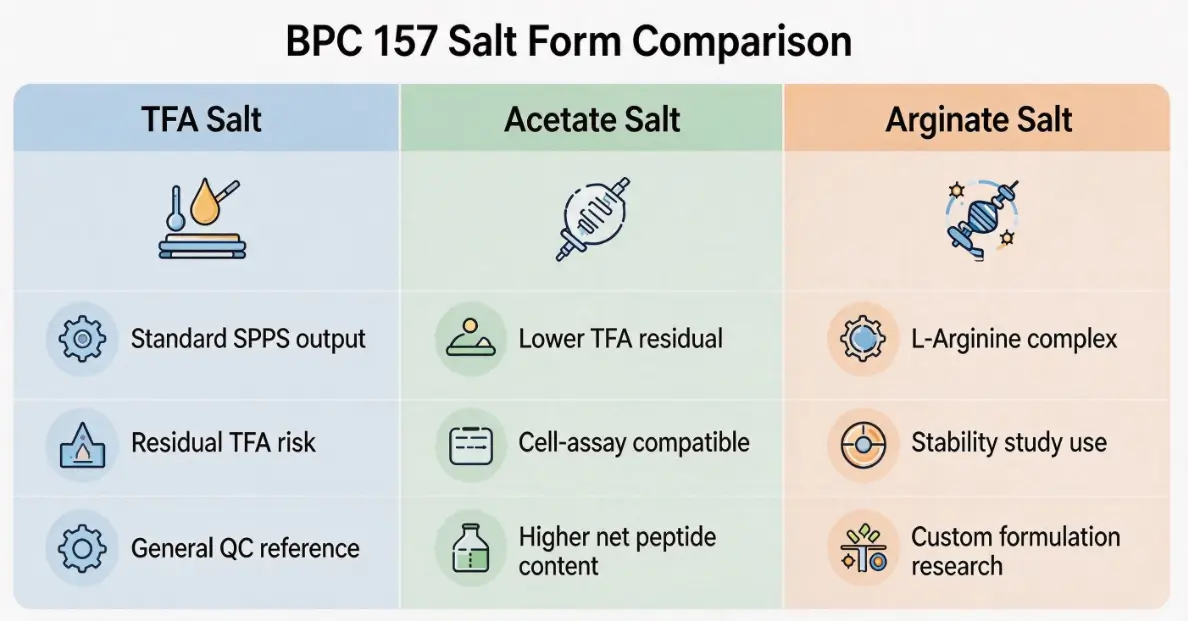
| Feature | TFA Salt | Acetate Salt | Arginate Salt |
|---|---|---|---|
| Manufacturing |
Standard output directly from SPPS and TFA-buffered RP-HPLC. |
Requires post-purification ion-exchange chromatography or HPLC re-purification. |
Formed by complexing free-base/acetate BPC 157 with L-arginine. |
| In Vitro Compatibility | Moderate. Residual TFA may inhibit cell proliferation or alter buffer pH. |
High. Acetate is a natural biological buffer component with minimal interference. |
High. Frequently studied for enhanced stability across broader pH ranges. |
| Net Peptide Content | Lower (typically 70%–85%) due to heavier TFA ions (114.02 g/mol each). |
Higher (typically 80%–90%) due to lighter acetate ions (60.05 g/mol each). |
Lower gross weight percentage due to heavier arginine counterions (174.20 g/mol). |
| Primary Use Case | Analytical reference standards, HPLC method validation, general QC. |
Sensitive cell-based assays, enzymatic screening, formulation R&D. |
Specialized stability studies and custom formulation research. |
| Cost & Lead Time | Most economical; fastest turnaround from catalog stock. |
Higher cost and +3 to 7 days lead time for ion exchange and residual testing. |
Custom synthesis pricing and lead time based on batch specifications. |
3 Critical QC Checkpoints for R&D Teams and Peptide Distributors
- 1. Never Confuse HPLC Purity with Net Peptide Content
A batch of BPC 157 showing ≥98% purity on an RP-HPLC chromatogram only measures the ratio of the target peptide peak relative to other UV-absorbing organic impurities. It does not account for non-UV-absorbing counterions (TFA or acetate) or bound moisture, which typically make up 10% to 30% of the gross lyophilized powder weight. For precise molarity preparation, R&D teams should verify Net Peptide Content via Amino Acid Analysis (AAA) or Elemental Nitrogen Analysis. - 2. Verifying Residual TFA in Acetate Salt Batches
When ordering BPC 157 acetate salt for sensitive cell culture workflows, requesting a standard HPLC/MS report is insufficient. Distributors and QC managers should verify that the supplier performs a dedicated counterion check—such as Ion Chromatography (IC) or ¹⁹F-NMR spectroscopy—to confirm that residual TFA levels are reduced below the project's threshold (commonly <0.5% or <0.1% w/w). - 3. Interpreting Mass Spectrometry (MS) Adduct Peaks
In ESI-MS analysis of BPC 157, the primary protonated molecular ions appear around m/z 1420.5 ([M+H]⁺) and m/z 710.8 ([M+2H]²⁺), aligning with the 1419.54 g/mol free-base mass. Depending on the salt form and mobile phase conditions, minor adduct signals such as [M+TFA+H]⁺ or sodium/potassium adducts may appear. Providing clear salt form specifications to your analytical lab prevents misidentifying counterion adducts as synthesis impurities.
Partnering with a Technically Transparent BPC 157 Manufacturer
- Partnering with a Technically Transparent BPC 157 Manufacturer
Whether your organization requires catalog-grade BPC 157 TFA salt for analytical testing or custom acetate/arginate salt conversion for specialized R&D workflows, confirming counterion specifications upfront eliminates costly batch rejections.At Guocheng Pharma, we supply high-purity BPC 157 Research Peptide (CAS 137525-51-0) manufactured under strict quality control (≥98% HPLC purity), supported by batch-specific COA, RP-HPLC, and MS spectra. For pharmaceutical R&D teams and global peptide distributors, we offer:- Custom Counterion Exchange: Reliable conversion to acetate or specialized salt forms with analytical verification.
- Flexible Packaging & Scale: From milligram research vials to bulk gram-scale lyophilized powder.
- B2B Confidentiality: Full NDA support and tailored documentation for commercial trading partners.