
TFA Salt vs. Acetate Salt in MOTS-c Synthesis: Which Counterion Should You Choose?
2026.11.17
MOTS-c TFA vs Acetate Salt (CAS 1627580-64-6) | Peptide Counterion Guide
When sourcing synthetic peptides like MOTS-c peptide (CAS 1627580-64-6), most buyers focus heavily on HPLC purity and mass spectrometry (MS) confirmation. However, experienced peptide chemists and formulation researchers know that counterion selection—specifically choosing between Trifluoroacetate (TFA) salt and Acetate salt—can significantly impact experimental outcomes, cellular viability, and downstream stability.
During standard Fmoc solid-phase peptide synthesis (SPPS) and reverse-phase HPLC purification, peptides naturally bind to negatively charged counterions via their basic amino acid residues. Given that the 16-amino-acid sequence of MOTS-c (MRWQEMGYIFYPRKLR) contains multiple basic residues—including three Arginines (Arg) and one Lysine (Lys)—counterions make up a notable portion of the final lyophilized powder mass.
In this technical guide, we break down the key differences between MOTS-c TFA salt and MOTS-c Acetate salt to help you select the optimal specification for your project.
1. What Is MOTS-c TFA Salt?
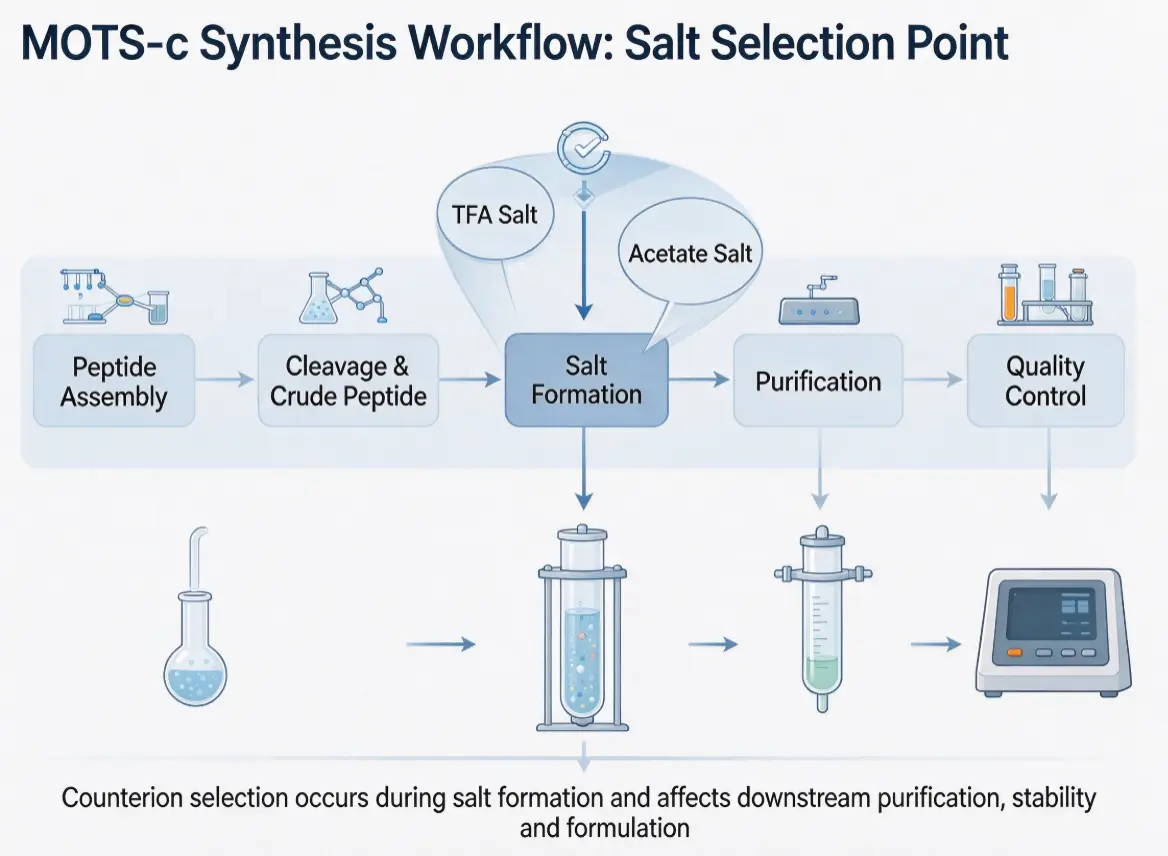
Trifluoroacetic acid (TFA) is the industry-standard cleavage reagent and mobile-phase modifier used during reverse-phase HPLC purification. Consequently, TFA salt is the default counterion form for most commercially available research peptides.
- Key Advantages:
- High Solubility: TFA salts generally exhibit excellent solubility in aqueous buffers and organic solvents, making them straightforward to reconstitute for routine benchtop assays.
- Cost-Effectiveness & Fast Lead Time: Because no secondary ion-exchange step is required, TFA-form MOTS-c is faster to manufacture and more economical for initial screening.
- Potential Limitations:
- Cellular & Biological Interference: Residual TFA ions at micromolar concentrations can occasionally alter cell proliferation, induce mild cytotoxicity in sensitive primary cell lines, or interfere with specific receptor-binding assays.
2. What Is MOTS-c Acetate Salt?
MOTS-c Acetate salt is produced by subjecting the purified TFA-form peptide to an additional ion-exchange chromatography or lyophilization counterion-swap process to substitute trifluoroacetate with biocompatible acetate ions.
- Key Advantages:
- Superior Biocompatibility: Acetate eliminates potential TFA-induced cellular stress, making it ideal for sensitive in vitro cell cultures, in vivo animal models, and advanced R&D.
- Regulatory Alignment: Closely mirrors standard pharmaceutical salt profiles for preclinical and formulation studies.
- Potential Limitations:
- Higher Cost & Yield Loss: Requires extra processing time and can experience minor yield loss during ion exchange.
- Solubility Variations: Acetate salts may occasionally require gentle warming or brief sonication to dissolve fully depending on buffer pH.
3. Side-by-Side Comparison: MOTS-c TFA Salt vs. Acetate Salt
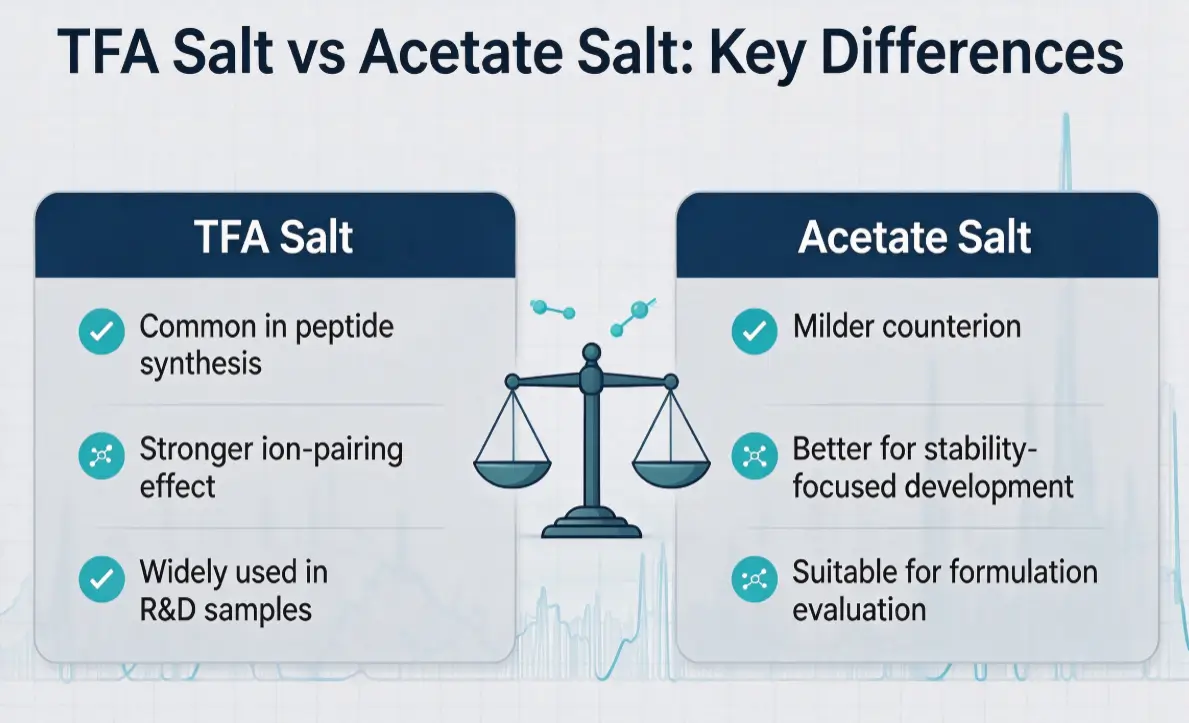
| Evaluation Criteria | MOTS-c TFA Salt (Standard) | MOTS-c Acetate Salt (Custom Exchange) |
|---|---|---|
| Manufacturing Process | Standard RP-HPLC purification | RP-HPLC + Secondary ion-exchange step |
| Biocompatibility | Good for biochemical & cell-free assays | Superior; non-toxic to sensitive cell lines |
| Aqueous Solubility | Very high in water and PBS | High (may need brief sonication) |
| Lead Time | Fast (in-stock or short synthesis cycle) | Additional 3–5 days for salt conversion |
| Cost Efficiency | Most economical for bulk screening | Moderate premium due to extra processing |
| Recommended Use | Analytical standards, initial in vitro screening | Sensitive cell culture, in vivo models, formulation R&D |
4. Manufacturer Support and Product Overview
Shandong Juntai Pharmaceutical Co., Ltd. supplies high-purity MOTS-c with customizable counterion specifications and verified quality metrics. For complete details on manufacturing standards, technical data, and sourcing options, please visit the Juntai Pharma Product Page.


