
The Four Identities of SS-31 (Elamipretide): What Exactly Did the FDA Approve?
2026.11.16
You searched for "SS-31". You read "FDA approved". But the product the FDA approved isn't named SS-31.
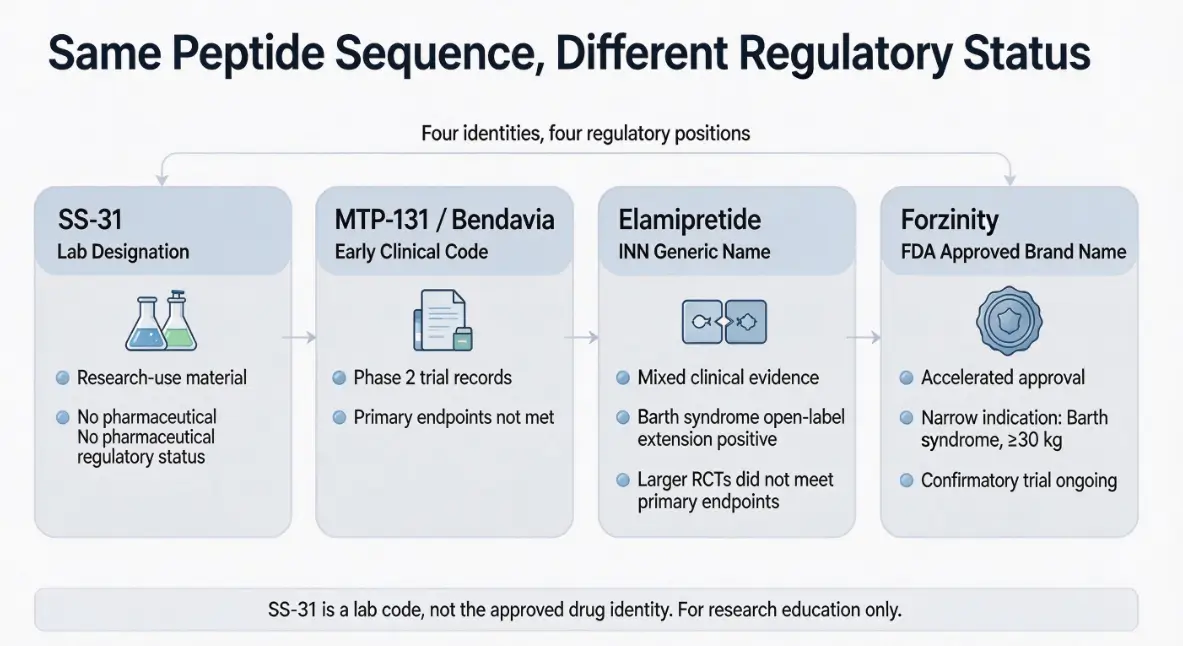
On September 19, 2025, the FDA granted accelerated approval to Forzinity (elamipretide) to improve muscle strength in adults and pediatric patients with Barth syndrome who weigh at least 30 kg. This is a fact. However, Forzinity is the brand name, elamipretide is the generic name, and "SS-31" is a laboratory code. While these three names refer to the exact same tetrapeptide sequence, they occupy entirely different positions within the regulatory system. The "SS-31" you see on peptide e-commerce sites or research forums is legally not Forzinity, nor does its evidence tier equate to the data that supported Forzinity's approval.
This article aims to untangle this name chain and place each identity back into its proper context.
SS-31 – A Laboratory Code, Not a Product Name
The "SS" in SS-31 stands for Szeto-Schiller, referencing the work of Hazel Szeto and Peter Schiller at Weill Cornell Medicine who designed this class of peptides. SS-31 is the laboratory designation for this specific sequence.
Chemically, it is a water-soluble tetrapeptide with a molecular weight of approximately 639.8 g/mol and a net charge of +3. It can penetrate cell membranes and localize to the inner mitochondrial membrane, where it binds to cardiolipin. This binding occurs through electrostatic and hydrophobic interactions, preventing cardiolipin from converting cytochrome c into a peroxidase while protecting its electron carrier function.
This code is widely used in academic literature, but it carries no regulatory meaning. The vast majority of pages you encounter when searching for "SS-31 peptide"—research-use labels, Certificates of Analysis (COA), and peptide e-commerce listings—correspond to the material state represented by this lab code.
The name SS-31 itself says nothing about purity standards, manufacturing practices, or clinical evidence.
MTP-131 and Bendavia – The Temporary Labels of Clinical Development
When SS-31 moved from the lab into clinical development, it acquired new labels. MTP-131 (Mitochondria-Targeting Peptide-131) was the development code, and Bendavia was the early brand name candidate. These names correspond to the preclinical and early-phase clinical trial stages.
The name Bendavia appears in records of several completed trials that ultimately shaped the molecule's trajectory:
EMBRACE-STEMI: Missed Primary Endpoint
EMBRACE-STEMI was a Phase 2a trial evaluating Bendavia (MTP-131) for reperfusion injury in patients with acute anterior myocardial infarction. The primary endpoint—infarct size—was not met: the 72-hour CK-MB area under the curve was 5785 ± 426 ng·h/mL in the placebo group and 5570 ± 486 ng·h/mL in the MTP-131 group, a non-significant difference.
PROGRESS-HF: Missed Primary Endpoint
PROGRESS-HF was a Phase 2 trial in patients with heart failure with reduced ejection fraction, enrolling 71 patients randomized to placebo, 4 mg, or 40 mg of elamipretide daily for 28 days. The primary endpoint—change in left ventricular end-systolic volume—was also not met: volume decreased from 89.4 mL to 85 mL in the 4 mg group, and from 77.9 mL to 76.6 mL in the 40 mg group, compared to a decrease from 77.7 mL to 74.6 mL with placebo. None of these intergroup differences were statistically significant.
The development stage represented by the names Bendavia and MTP-131 left behind two negative Phase 2 results. These results do not invalidate the mechanism of cardiolipin targeting itself, but they demonstrate a crucial point: in human trials, the "mitochondrial targeting" label does not automatically translate into clinical endpoint benefits.
Elamipretide – The INN Binding a Mixed Evidence Profile
Elamipretide is the International Nonproprietary Name (INN) for this sequence and the name used in FDA approval documents. However, the evidence landscape covered by this name is highly divided.
The Positive Signal: Barth Syndrome Open-Label Extension
The data for Barth syndrome is positive and concentrated. TAZPOWER (SPIBA-201, NCT03098797) was a Phase 2/3 randomized, double-blind, placebo-controlled crossover trial. Twelve genetically confirmed Barth syndrome patients were randomized to 40 mg/day elamipretide or placebo for 12 weeks, followed by a 192-week open-label extension.
-
Initial Phase: In the randomized phase, the two primary endpoints—6-minute walk distance and fatigue score—did not reach statistical significance.
-
Extension Phase: However, in the open-label extension, an improvement in knee extensor muscle strength was observed (median change of 63 Newtons at week 168). This intermediate clinical endpoint formed the basis for the accelerated approval.
The Negative Reality: MMPOWER-3 and ReCLAIM-2
But for the same generic name, the performance in other indications is entirely different.
MMPOWER-3 (Primary Mitochondrial Myopathy)
MMPOWER-3 was a Phase 3 trial enrolling 202 patients with genetically confirmed primary mitochondrial myopathy (101 per arm), randomized to 40 mg/day elamipretide or placebo for 24 weeks. Both primary endpoints were missed: there were no significant differences between the elamipretide and placebo groups in either the 6-minute walk test or the PMMSA total fatigue score.
ReCLAIM-2 (Dry AMD with Geographic Atrophy)
ReCLAIM-2 evaluated 40 mg daily subcutaneous injections of elamipretide for 48 weeks in 176 patients with dry age-related macular degeneration with geographic atrophy. The primary endpoints—low-luminance best-corrected visual acuity and the square root-transformed geographic atrophy area—also failed to reach statistical significance.
Looking at TAZPOWER, MMPOWER-3, and ReCLAIM-2 together, the conclusion is clear: the molecule represented by the name elamipretide showed improvements in knee extensor strength in the Barth syndrome open-label extension, but failed to replicate these benefits on pre-specified primary endpoints in larger randomized controlled trials for primary mitochondrial myopathy and macular degeneration. "Mitochondrial dysfunction" as a broad category is not a target that this molecule can solve universally.
Forzinity – The Only Name with Regulatory Status, but with a Narrow Scope
Forzinity is the brand name granted accelerated approval by the FDA on September 19, 2025. Its indication is strictly limited to: Barth syndrome, weight at least 30 kg, to improve muscle strength.
A Narrow Indication Based on a Surrogate Endpoint
The approval is based on the intermediate clinical endpoint of "knee extensor muscle strength"—the FDA considers this improvement "reasonably likely to predict clinical benefit," but it did not directly evaluate functional improvement or survival benefits. As a condition of accelerated approval, a confirmatory trial is a post-marketing requirement: the FDA requires the sponsor to conduct a randomized, double-blind, placebo-controlled trial to confirm whether changes in knee extensor strength translate into patient benefits. 4TAZPower (SPIBA-401, NCT07531251) is already advancing as a Phase 3b/4 confirmatory trial.
The 12-Patient Pivotal Trial and Pending Obligations
The scale of the trial supporting this approval also requires precise context. FDA Drug Trials Snapshots indicate that the pivotal trial enrolled 12 patients with Barth syndrome at a single center, all male, aged 12 years and older.
This is not a dismissive statement—Barth syndrome is an ultra-rare disease, and small sample sizes are the norm. But it means: the evidence base for Forzinity's regulatory status is a 12-patient crossover trial plus an open-label extension, and the two primary endpoints of that crossover trial did not achieve statistical significance. The outcome of the confirmatory trial will determine whether this accelerated approval converts to traditional approval.
Four Names, Four Levels of Distance
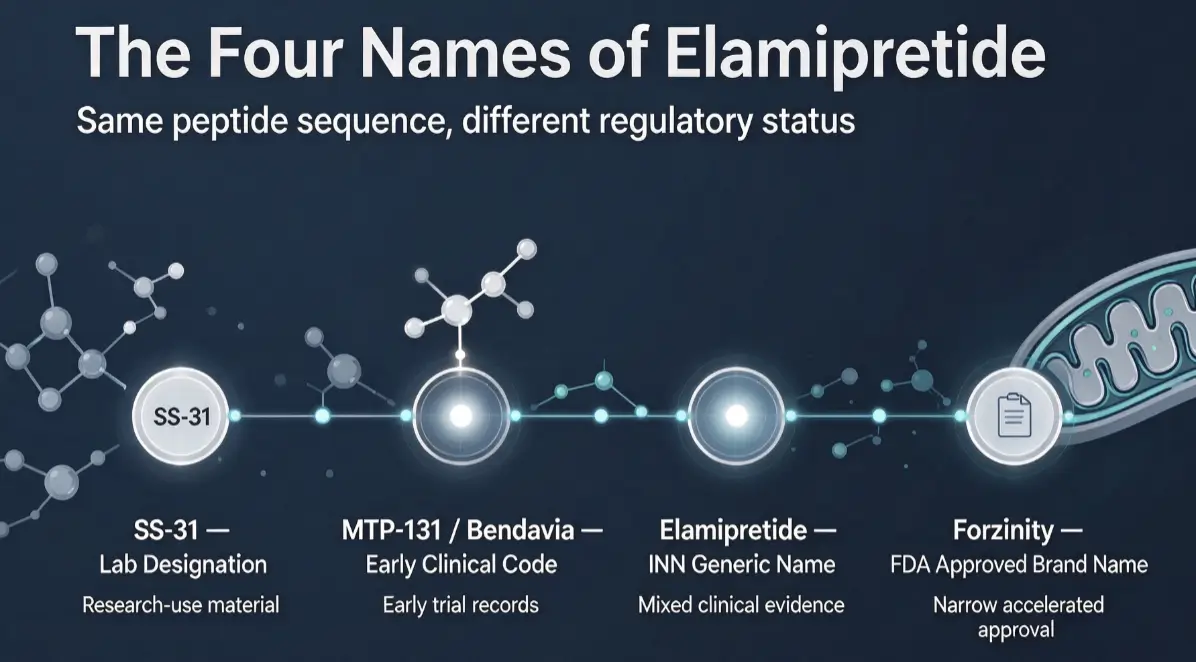
When you place this chain together, what you see is not "four different names for one peptide," but rather the projection of a single molecule across four different institutional positions:
The Identity Breakdown
-
SS-31 (Laboratory code): Corresponds to research-use material, carrying no pharmaceutical-grade regulatory status.
-
MTP-131 / Bendavia (Early development codes): Corresponds to two Phase 2 records that missed their primary endpoints (EMBRACE-STEMI, PROGRESS-HF).
-
Elamipretide (INN): Corresponds to a divided evidence profile: positive open-label extension data in Barth syndrome, but negative primary endpoints in MMPOWER-3 and ReCLAIM-2.
-
Forzinity (FDA-approved brand name): Corresponds to an accelerated approval, extremely narrow indication, and a 12-patient pivotal trial, with confirmatory obligations still pending.
When you read "FDA approved" on a page labeled "SS-31," the three middle links in this chain are precisely what is being omitted. The FDA approved Forzinity, for patients with Barth syndrome weighing ≥30 kg, based on the surrogate endpoint of knee extensor strength, with core evidence from 12 patients. The confirmatory trial is still ongoing.
If You Arrived Here Because of the "FDA Approval"
You first need to answer one question: When you search for "SS-31," which name's corresponding entity are you actually looking for?
Distinguishing the Regulatory Gap
If you are looking for an approved therapy for Barth syndrome, the regulatory status belongs to Forzinity, not to the laboratory code SS-31. If you are looking for "mitochondrial function," "energy," or "anti-aging," the human randomized controlled trial data for this name chain currently points to the negative primary endpoints of MMPOWER-3 and ReCLAIM-2, as well as the negative results of PROGRESS-HF and EMBRACE-STEMI. It is not that "it hasn't been studied," but rather "it was studied, and the primary endpoints were not met."
The Role of the COA (Certificate of Analysis)
As for the Certificate of Analysis (COA) in your hand labeled "SS-31" or "Elamipretide"—HPLC purity, impurity profile, endotoxin levels—it demonstrates the batch-to-batch consistency of this material at the analytical chemistry level. It does not indicate that this material holds the regulatory status of Forzinity, nor does it constitute a conclusion regarding human safety or efficacy.
The distance between SS-31 as a lab code and Forzinity as an approved drug is not a gap that a COA can fill. The gap is made up of the TAZPOWER open-label data, the negative randomized controlled results of MMPOWER-3, and a confirmatory trial that has yet to be completed.


