
Formulating with NAD+, Peptides & Hyaluronic Acid: How Raw Material Quality Impacts Serum Stability
2026.10.29
In today's anti-aging skincare market, advanced serums increasingly rely on multi-active formulations rather than a single hero ingredient. By combining NAD+ (cellular energy and DNA repair), peptides (structural signaling), and hyaluronic acid (HA) (hydration and rheology), formulators can develop an "Energy-Signal-Environment" matrix designed to address multiple formulation objectives.
However, combining these ingredients presents distinct formulation challenges. While each ingredient offers specific functional properties, maintaining the physical and chemical stability of a multi-active system requires careful control of formulation parameters and raw material quality.
Even a well-designed formulation can encounter stability issues when raw material quality is inconsistent or insufficiently characterized. Why do some carefully developed NAD+ peptide serums fail during accelerated stability testing? In many cases, the problem extends beyond the formulation strategy itself to the purity and compatibility of the raw materials.
The Formulation Reality: Three Critical Challenges
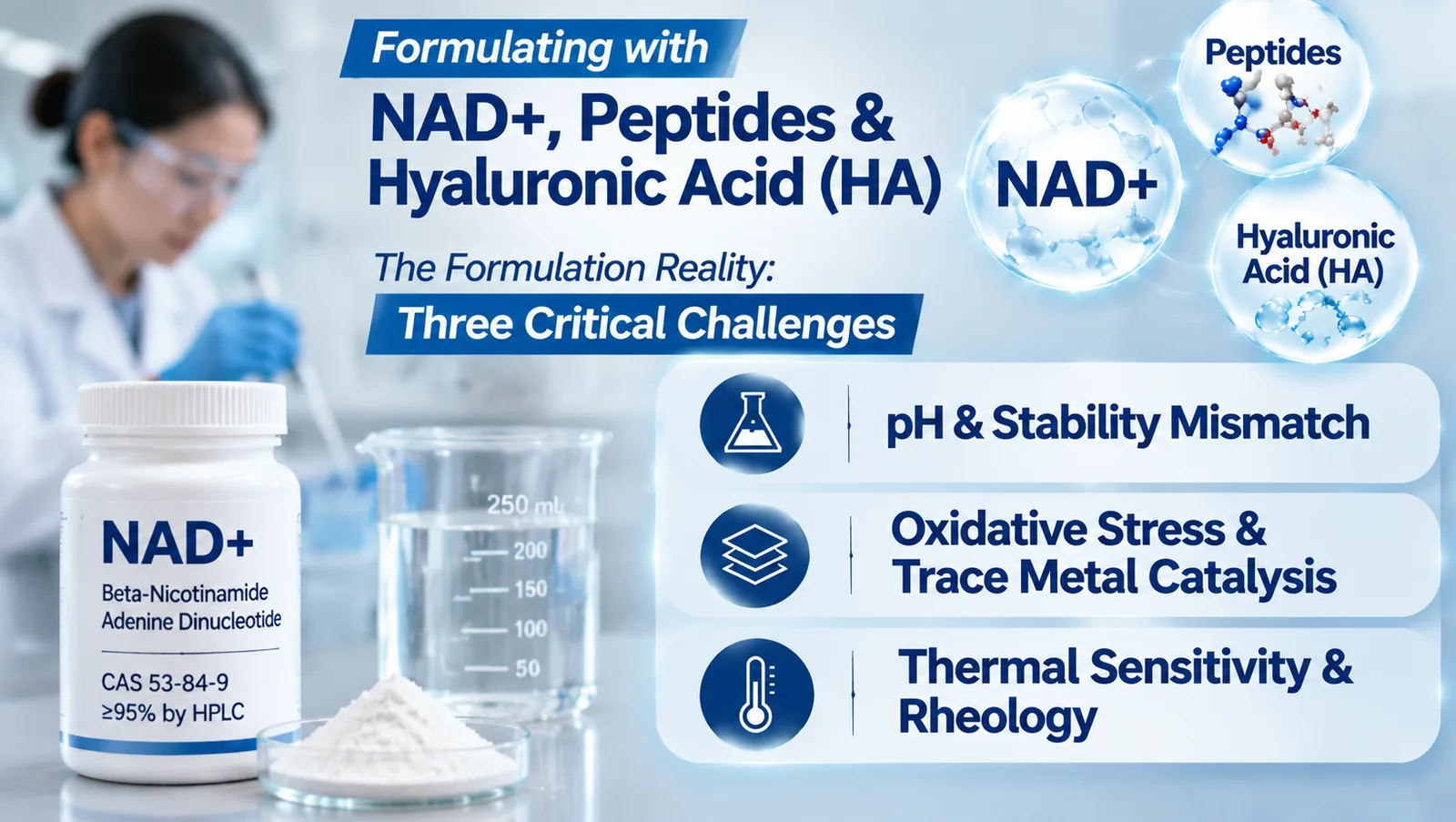
When formulating with NAD+, peptides, and HA, formulators must address three key technical challenges.
1. pH and Stability Mismatch
NAD+ stability is influenced by pH, temperature, and buffer composition. Unlike NADH, oxidized NAD+ is susceptible to base-catalyzed degradation under alkaline conditions.
Peptide stability, meanwhile, depends heavily on the specific amino acid sequence. Depending on their structure and formulation environment, peptides may undergo hydrolysis, deamidation, or aggregation outside their optimal pH range. A comprehensive review by Nugrahadi et al. examines these degradation pathways in therapeutic peptides formulated in aqueous solutions, providing relevant insights for the development of cosmetic peptide formulations.
The viscosity of HA solutions is also sensitive to pH and ionic strength. Formulators must therefore evaluate these variables within the intended formulation environment rather than assume a universal pH tolerance.
(Wolfe et al., 2024; Nugrahadi et al., 2023; Snetkov et al., 2020)
2. Oxidative Stress and Trace Metal Catalysis
Trace metal ions, particularly iron and copper, can accelerate the oxidation of peptides. Although the direct mechanism of metal-catalyzed NAD+ degradation in cosmetic emulsions requires further investigation, these transition metals can introduce additional variables into complex aqueous formulations.
Appropriate chelation strategies and well-characterized raw materials are important considerations when minimizing oxidative degradation risks in multi-active systems.
3. Thermal Sensitivity and Rheology
NAD+ should be introduced during a verified cool-down phase, typically below 40°C, to minimize thermal degradation. This temperature is a processing target rather than a universal stability threshold and should be validated for the specific formulation.
For high-molecular-weight HA, processing temperature and shear conditions can influence its rheological behavior and viscosity, affecting the final texture of the serum. Formulators must distinguish reversible shear-thinning from actual molecular chain degradation when evaluating processing conditions.
Balancing the processing requirements of HA with the thermal sensitivity of NAD+ requires careful process control.
(Snetkov et al., 2020)
The Root Cause: Why NAD+ Raw Material Quality Matters
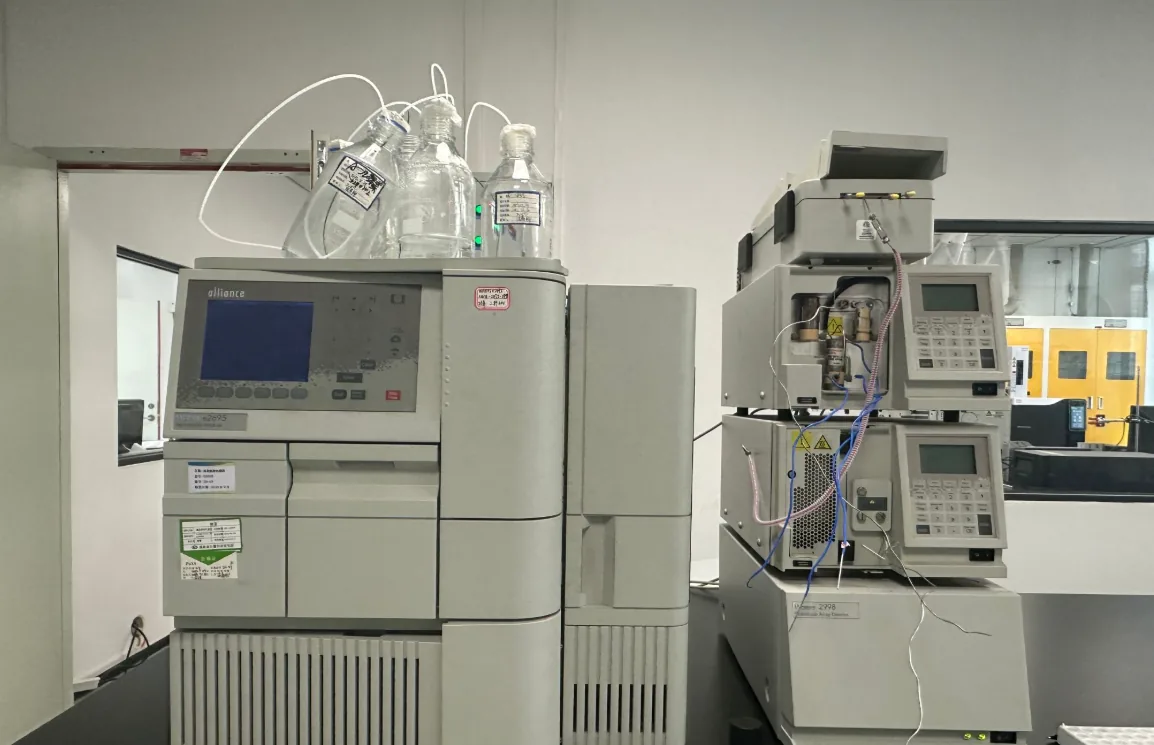
To address these challenges, formulators carefully optimize processing sequences, select appropriate chelating agents, and verify the final formulation pH. However, even a well-developed formulation cannot fully compensate for poorly characterized raw materials.
If your NAD+ powder contains elevated levels of residual solvents or specific degradation byproducts, such as ADP-ribose or nicotinamide, these components must be evaluated according to their identity and concentration. Uncontrolled impurity levels may introduce additional risks to formulation stability.
Similarly, the molecular weight distribution of the HA raw material directly influences its rheological properties and the viscosity profile of the final formulation.
A stability failure should therefore trigger a systematic review of the entire formulation, manufacturing process, packaging, storage conditions, and raw material quality. Supplier qualification is an important part of this investigation.
How to Evaluate an NAD+ Supplier for Complex Formulations
For R&D professionals and procurement managers, selecting an NAD+ manufacturer involves more than comparing prices. Three quality and service criteria deserve particular attention.
1. It's Not Just About Purity; It's About the Impurity Profile
A standard COA may report a purity of 95% by HPLC. However, an HPLC purity result alone does not provide a complete picture of raw material quality.
Its interpretation depends on the analytical method and calculation basis. It does not automatically identify or quantify all impurities, including water, residual solvents, or elemental contaminants.
When evaluating an NAD+ supplier, look for detailed chromatographic data and supporting analytical results for relevant elemental impurities and residual solvents. Understanding the impurity profile provides a more comprehensive basis for assessing raw material suitability in sensitive formulations.
2. Batch-to-Batch Consistency
For a multi-active system containing NAD+, peptides, and HA, batch-to-batch consistency is an important consideration.
Variations in raw material specifications or impurity profiles can introduce additional variables during formulation development, potentially affecting stability and viscosity.
A reliable NAD+ supplier should demonstrate appropriate manufacturing controls and quality assurance procedures, supported by batch-specific analytical records. Consistent raw material specifications help formulators reduce variability when repeating laboratory trials and evaluating scale-up processes.
3. Technical Support & Documentation
A reliable B2B supplier should provide more than a product specification. Technical documentation, including Technical Data Sheets (TDS) and Certificates of Analysis (COA), helps R&D teams evaluate raw material suitability before formulation trials.
When working with NAD+ peptide formulations, access to relevant information on solubility, pH compatibility, and processing conditions can help identify potential formulation challenges at an earlier stage.
Clear technical communication and accessible quality documentation are important factors when establishing a long-term raw material supply relationship.
Sourcing with Confidence: The H2O Pharm Advantage
At H2O Pharm, we recognize that raw material quality is an important factor in the development of reliable cosmetic formulations.
We supply Beta-Nicotinamide Adenine Dinucleotide (NAD+) (CAS 53-84-9), with a specified HPLC purity of ≥95%, for further formulation development and industrial applications.
Why formulators and purchasing managers choose H2O Pharm:
-
≥95% HPLC Purity: Our NAD+ raw material is supplied with a specified HPLC purity of ≥95%, supported by product quality documentation.
-
Quality Assurance: Our quality management processes support the evaluation of product specifications and batch quality.
-
Flexible Supply Chain: We support customer requirements ranging from gram-level R&D trials to bulk NAD+ commercial procurement.
-
Technical Partnership: Our R&D team is available to discuss product specifications, technical documentation, and ingredient compatibility considerations for formulation development.
For cosmetic ingredient manufacturers, formulators, and raw material distributors, selecting a suitable NAD+ supplier is an important step in building a consistent and well-characterized raw material supply chain.
Ready to Evaluate NAD+ for Your Next Formulation?
Start with a clear understanding of your raw material requirements.
[👉 Request a Free NAD+ Sample] to begin your formulation trials, or [👉 Contact Our Technical Team] to request available TDS, COA, and impurity profile information.
References
-
Wolfe, K. D., Alahuhta, M., Himmel, M. E., Bomble, Y. J., Jennings, G. K., & Cliffel, D. E. (2024). Long-Term Stability of Nicotinamide Cofactors in Common Aqueous Buffers: Implications for Cell-Free Biocatalysis. Molecules, 29(22), 5453. https://doi.org/10.3390/molecules29225453
-
Nugrahadi, P. P., Hinrichs, W. L. J., Frijlink, H. W., Schöneich, C., & Avanti, C. (2023). Designing Formulation Strategies for Enhanced Stability of Therapeutic Peptides in Aqueous Solutions: A Review. Pharmaceutics, 15(3), 935. https://doi.org/10.3390/pharmaceutics15030935
-
Snetkov, P., Zakharova, K., Morozkina, S., Olekhnovich, R., & Uspenskaya, M. (2020). Hyaluronic Acid: The Influence of Molecular Weight on Structural, Physical, Physico-Chemical, and Degradable Properties of Biopolymer. Polymers, 12(8), 1800. https://doi.org/10.3390/polym12081800


