
![Fmoc-L-Lys[C20-OtBu-γ-Glu(OtBu)-AEEA-AEEA]-OH](/upload/2026/7/89-1.jpg "Fmoc-L-Lys[C20-OtBu-γ-Glu(OtBu)-AEEA-AEEA]-OH")
Octadecanedioic Acid Derivatives in Multistep Organic Synthesis
2026.08.20
Octadecanedioic Acid and Its Protected Derivatives in Multistep Organic Synthesis
Octadecanedioic Acid contains two chemically similar terminal carboxyl groups.
That symmetry is useful when both ends of the molecule need to react, but it can become a challenge when a synthetic route requires modification of only one end at a time.
This is where protected derivatives become valuable.
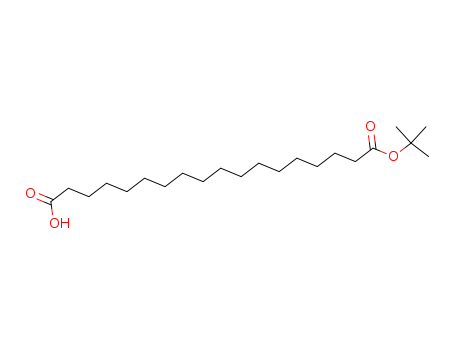
A representative example is 18-(tert-butoxy)-18-oxooctadecanoic acid, CAS 843666-40-0, which TCI identifies as:
-
Mono-tert-butyl Octadecanedioate;
-
Octadecanedioic Acid Mono-tert-butyl Ester;
-
tert-Butyl Hydrogen Octadecanedioate.
The compound retains one free carboxylic acid while the second carboxyl functionality is present as a tert-butyl ester.
This creates an asymmetric, selectively addressable version of the C18 diacid framework.
Why Protect One End of a Dicarboxylic Acid?
Unprotected Octadecanedioic Acid contains reactive carboxyl groups at both termini.
If a project requires selective modification at one end, uncontrolled reaction at both sites may produce mixtures or make route design more difficult.
A mono-protected derivative changes the situation:
Free COOH — C18 framework — Protected carboxyl functionality
This allows researchers to distinguish between the two ends during multistep structural development.
The protection strategy does not change the underlying C18 carbon skeleton; it changes how the terminal functionality can be managed during synthesis.
What Is 18-(tert-Butoxy)-18-oxooctadecanoic Acid?
18-(tert-Butoxy)-18-oxooctadecanoic acid has CAS No. 843666-40-0.
PubChem reports a molecular weight of approximately 370.6 g/mol, while TCI identifies the material as the mono-tert-butyl ester of Octadecanedioic Acid.
| Property | Information |
|---|---|
| Product | 18-(tert-Butoxy)-18-oxooctadecanoic acid |
| CAS No. | 843666-40-0 |
| Structural Type | Mono-protected long-chain dicarboxylic acid |
| Common Description | Mono-tert-butyl Octadecanedioate |
| Key Functionality | One free carboxyl group + one tert-butyl ester |
| Carbon Framework | C18-derived long-chain structure |
How Does Selective Protection Support Route Design?
Stepwise Functionalization
A free carboxyl group can be used as the primary point for downstream transformation while the protected end remains temporarily unavailable.
This makes it possible to design molecules that contain different structures at opposite ends of the original diacid framework.
Asymmetric Molecule Development
Unprotected Octadecanedioic Acid is structurally symmetric.
Mono-protection converts it into a practical asymmetric intermediate from the perspective of reactivity.
This can be useful in the development of:
-
long-chain linker structures;
-
peptide-related side-chain components;
-
functionalized ester or amide derivatives;
-
other bifunctional molecular architectures.
Later Access to the Protected Functionality
Commercial technical descriptions for CAS 843666-40-0 note that the free carboxylic acid can undergo downstream coupling chemistry while the tert-butyl-protected functionality can later be exposed for further structural development.
The exact reaction sequence, conditions and suitability should always be determined within the specific R&D route.
Free Octadecanedioic Acid or Protected Derivative?
The correct form depends on what the chemist wants to achieve.
Use Free Octadecanedioic Acid When:
-
both carboxyl groups are intended to participate;
-
symmetry is acceptable;
-
polymer or bifunctional chemistry is required;
-
selective differentiation of the ends is unnecessary.
Consider a Mono-Protected Derivative When:
-
only one end should react initially;
-
sequential functionalization is required;
-
an asymmetric target structure is being developed;
-
later access to the second carboxyl functionality is desired.
The protected derivative is therefore not simply a “higher-value version” of Octadecanedioic Acid. It serves a different synthetic purpose.
Why This Matters in Linker Chemistry
Long-chain linker development often involves several different structural elements.
A project may require:
-
a hydrophobic C18 segment;
-
a linker or spacer;
-
an amino-acid-derived component;
-
selective terminal functionality.
In such cases, starting from a mono-protected long-chain diacid can simplify structural planning because the two ends are no longer equivalent from a synthetic perspective.
This is particularly relevant to multi-component linker architectures where uncontrolled bifunctional reaction would be undesirable.
Quality Considerations for Protected Derivatives
Protected intermediates should not be evaluated solely on overall purity.
Important factors include:
Correct Protection State
Confirm that the material corresponds to the mono-protected structure rather than free Octadecanedioic Acid or a differently protected derivative.
Product Identity
CAS No. and structural information should be checked together.
Batch-Specific Analysis
The actual batch COA and available structural or purity data should be reviewed according to project requirements.
Storage and Handling
Storage conditions may differ between free diacids and protected derivatives. For example, commercial references for CAS 843666-40-0 provide specific storage recommendations, which should be checked against the supplier's batch documentation.
Frequently Asked Questions
What is Octadecanedioic Acid mono-tert-butyl ester?
It is a mono-protected form of Octadecanedioic Acid in which one terminal carboxyl functionality is protected as a tert-butyl ester.
What is the CAS number?
18-(tert-Butoxy)-18-oxooctadecanoic acid is CAS 843666-40-0.
Why not simply use Octadecanedioic Acid?
Free Octadecanedioic Acid is suitable when both carboxyl groups can participate. A mono-protected derivative is more useful when the two ends need to be modified sequentially.
Are free ODDA and mono-tert-butyl ODDA interchangeable?
No. They have different functional states and should be selected according to the target synthetic route.
Support for Long-Chain Diacid Projects
Shandong Juntai Pharmaceutical supports Octadecanedioic Acid and related functionalized long-chain intermediates for research and project development.
The exact chemical form, purity requirement and documentation package should be confirmed for each project.
For research use only.


