
![Fmoc-L-Lys[C20-OtBu-γ-Glu(OtBu)-AEEA-AEEA]-OH](/upload/2026/7/89-1.jpg "Fmoc-L-Lys[C20-OtBu-γ-Glu(OtBu)-AEEA-AEEA]-OH")
Octadecanedioic Acid in Polyamides & Polyesters | C18 Diacid
2026.08.20
Octadecanedioic Acid in Polyamides and Polyesters: Why the C18 Chain Matters
For polymer researchers, Octadecanedioic Acid is interesting for a simple structural reason: it combines two polymer-reactive carboxyl groups with a long C18 aliphatic segment.
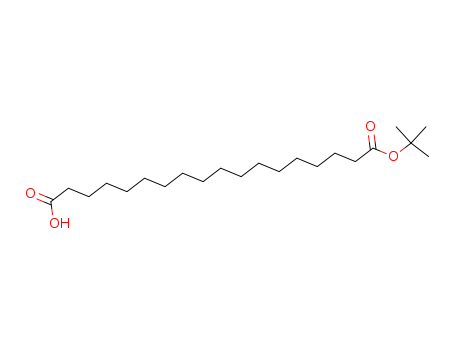
Octadecanedioic Acid, CAS 871-70-5, has the formula C₁₈H₃₄O₄ and molecular weight of approximately 314.46 g/mol.
This makes it a long-chain bifunctional monomer candidate for research involving polyamides, polyesters and other condensation-derived structures.
Unlike general supplier descriptions that simply list “polymer applications,” published research provides direct evidence that Octadecanedioic Acid has been incorporated into multiple polyamide systems.
Why Long-Chain Dicarboxylic Acids Matter in Polymer Design
Polymer structure is strongly influenced by the spacing and functionality of its monomers.
Octadecanedioic Acid contributes:
-
two terminal carboxyl groups;
-
a long aliphatic spacer;
-
a relatively low density of polar groups across its hydrocarbon segment.
This differs substantially from a short-chain diacid.
When such a monomer is incorporated into a polymer backbone, it changes the relative proportion of polar linkages and hydrocarbon segments.
The resulting effect on thermal, mechanical, solvent and surface properties depends on the complete polymer composition rather than on the diacid alone.
Octadecanedioic Acid in Polyamide Research
The strongest technical evidence for this application comes from published polymer studies.
Researchers have reported synthesis and characterization of several polyamides containing Octadecanedioic Acid, including:
-
nylon-2,18;
-
nylon-3,18;
-
nylon-4,18;
-
nylon-6,18;
-
nylon-8,18.
These naming conventions reflect the diamine and diacid carbon-chain components used to construct the polyamide.
What Has Research Shown for Nylon 6/6,18?
A 2006 study examined copolyamides containing nylon 6 and nylon 6,18 units in different ratios.
The researchers reported increasing resistance to organic solvents as the proportion of nylon 6,18 increased, measured through decreasing solubility.
This is important because it shows that changing the amount of long-chain C18 diacid-derived structure can materially alter polymer behavior.
It does not mean that Octadecanedioic Acid will automatically improve solvent resistance in every polymer.
Rather, it demonstrates why chain length is a meaningful design variable that deserves evaluation within a defined polymer system.
Why Does C18 Chain Length Change the Polymer Environment?
Consider two opposing structural contributions.
Polar Regions
Amide or ester linkages introduce polar functional groups capable of intermolecular interactions.
Aliphatic Regions
The long C18 segment introduces a comparatively non-polar hydrocarbon region.
Changing the ratio between these structural elements can alter:
-
molecular packing;
-
chain mobility;
-
hydrophobic character;
-
intermolecular interactions;
-
compatibility with solvents or other formulation components.
These relationships explain why long-chain diacids are studied as design tools rather than simply as substitutes for shorter diacids.
Octadecanedioic Acid in Polyester Research
The same bifunctionality that supports polyamide formation also allows Octadecanedioic Acid to participate in ester-forming systems.
In polyester research, a long-chain diacid can introduce a long aliphatic segment between ester-containing portions of the polymer.
Potential research areas include:
-
specialty polyesters;
-
polyester polyols;
-
long-chain ester materials;
-
functional resin systems.
The resulting material properties depend on the complete monomer composition, stoichiometry, molecular weight and processing conditions.
For this reason, claims such as “improves flexibility” or “improves hydrolysis resistance” should not be attributed to Octadecanedioic Acid universally without formulation-specific evidence.
C18 Diacid vs. Shorter Diacid Monomers
The main distinction is structural spacing.
Replacing a shorter diacid with a longer C18 diacid increases the length of the hydrocarbon segment between reactive ends.
This may change the balance between polar and non-polar sections of the polymer backbone.
For materials scientists, the correct question is therefore not:
“Is C18 better?”
It is:
“Does a C18 diacid provide the structural balance required for this polymer design?”
What Polymer R&D Teams Should Evaluate
Monomer Identity
Confirm that the material is Octadecanedioic Acid, CAS 871-70-5, rather than a C12, C20 or other long-chain diacid.
Purity and Impurity Profile
Impurities can influence downstream polymerization, especially when they alter functional-group balance or introduce unexpected reactive species.
Functional Group Equivalence
Because condensation polymerization depends on controlled functional-group ratios, raw-material specification can matter beyond a simple headline purity percentage.
Batch Consistency
When research moves from laboratory screening to repeated process evaluation, consistent raw-material characteristics become increasingly important.
Frequently Asked Questions
Can Octadecanedioic Acid be used in polyamides?
Yes. Published research has synthesized multiple Octadecanedioic Acid-containing polyamides, including nylon-6,18 and other long-chain systems.
What is nylon 6,18?
In this context, nylon 6,18 refers to a polyamide system incorporating a six-carbon diamine-derived component and an 18-carbon dicarboxylic-acid-derived component.
Is Octadecanedioic Acid also relevant to polyesters?
Its two carboxyl groups make it chemically suitable for ester-forming research with appropriate alcohol or polyol components.
Does C18 always produce better polymer properties?
No. Polymer performance depends on the complete formulation and processing conditions. Chain length is one design variable among many.
Material Development Support
For polymer and specialty-material projects using Octadecanedioic Acid, product evaluation should focus on chemical identity, specification, batch data and downstream process requirements.
Shandong Juntai Pharmaceutical can support technical discussions for R&D and manufacturing-related projects.


